 Moonshot AI / Kimi
Free
Moonshot AI / Kimi
Free
Moonshot AI (Dark Side of the Moon) is a Chinese AI startup. Its product Kimi is famous for its ultra-long context processing capabilities (the K3 flagship model supports 1M token context windows). Kimi has evolved from a single conversational assistant to an AI productivity platform covering Agent agents, in-depth research, code generation, and document collaboration Swarm multi-agent clusters. It also provides model API services such as K3, K2.6, and K2.7 Code through an open platform. Moonshot AI is one of the most competitive players in China’s AI large model circuit.
MoonshotAI/Kimi
Core parameters and statistics
Moonshot AI (Dark Side of the Moon) is a leading startup in China's AI large model track. Its product Kimi has evolved from a single conversation assistant to an AI productivity platform covering Agent intelligence, in-depth research, code generation, and document collaboration. The main delivery form is AI applications for end users (productivity/business-side applications), and model API services (basic model infrastructure) are provided through the open platform.
| Projects | Public Information |
|---|---|
| Product Positioning | AI Dialogue Assistant + Agent Productivity Platform + Model API Service |
| Flagship model | Kimi K3 (2.8T parameters, 1M token context, native multi-modal) |
| Model Matrix | K3 (Flagship), K2.7 Code (Programming), K2.6 (General), Moonshot V1 (Classic) |
| Platform coverage | Web, Android, iOS, Desktop, API |
| Place of Attribution | CN (Beijing Dark Side of the Moon Technology Co., Ltd.) |
| Business model | Freemium (free + subscription) + API pay-as-you-go |
| Team background | Founded by former Google Brain researcher Yang Zhilin |
| Latest Release | Kimi K3 (2026-07-16) |
Brief comment in one sentence: Kimi is not another AI chatbot, but a "Chinese AI productivity family bucket" with ultra-long context as the cornerstone and Agent as the growth engine - from throwing in a 1M token document to ask a few questions to letting the Swarm cluster autonomously complete multi-step research tasks, covering the full spectrum from light Q&A to heavy knowledge work.
Product Layout: Kimi's current product line spans six directions - AI dialogue (kimi.com), Agent (agent), deep-research (deep-research), code generation (Kimi Code), document collaboration (docs/sheets/slides), website construction (websites), and multi-agent cluster (Swarm). This kind of layout of "one account covering multiple AI productivity scenarios" is relatively rare among Chinese AI products.
User and market recognition of Moonshot AI / Kimi
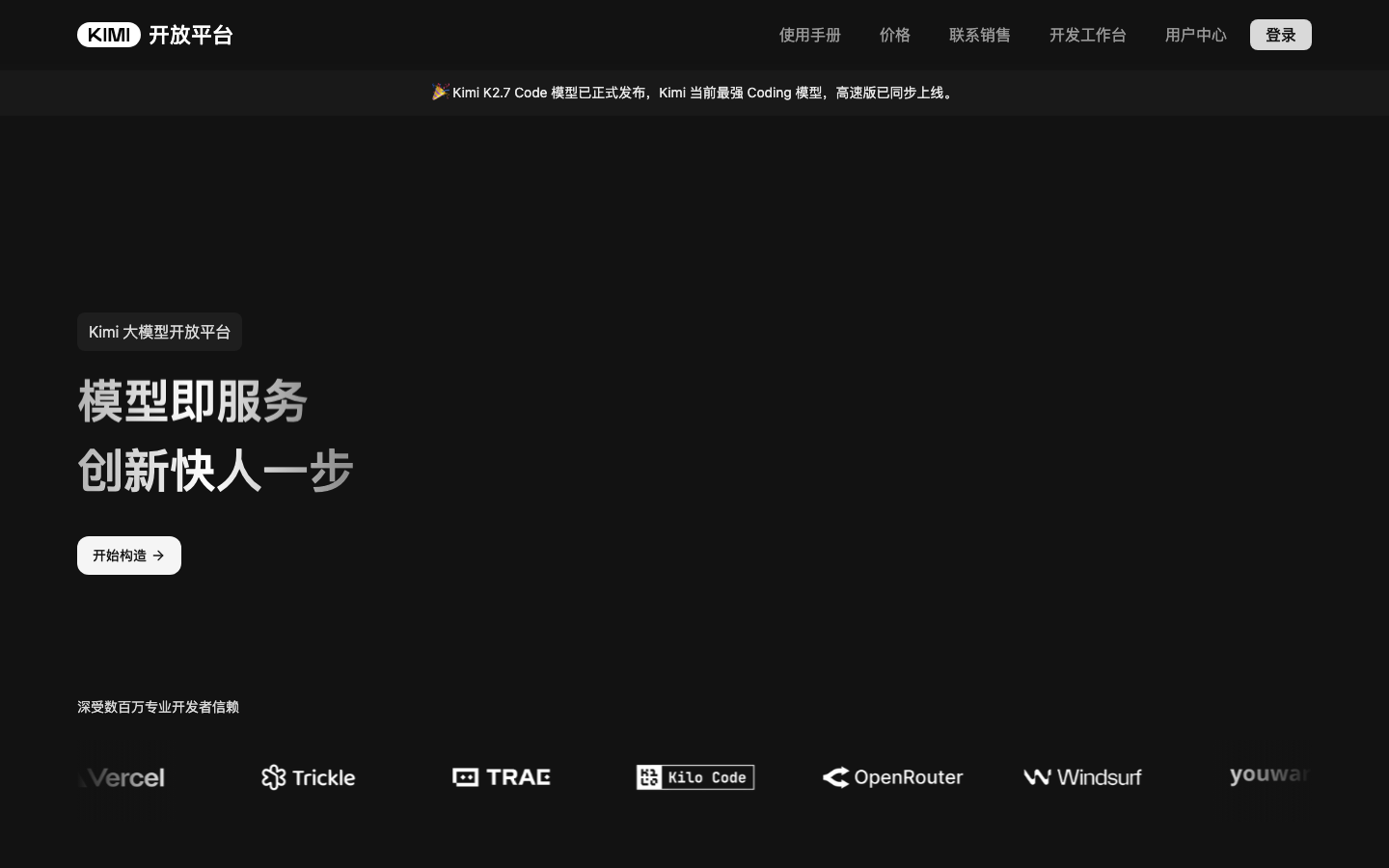
C-side user base: Kimi has established a strong differentiated perception among Chinese users with its ultra-long context capabilities. In scenarios such as Chinese long document analysis, academic paper reading, contract review, and book interpretation, Kimi's user reputation is significantly better than that of general international products. The product page shows that Kimi is trusted by "millions of professional developers" and its open platform partners include Vercel, Cursor, Windsurf, TRAE, Kilo Code, OpenRouter, Huawei, Xiaohongshu Coze, CodeBuddy and other leading companies and development tools.
B-side industry penetration: The official website of the open platform lists multiple benchmark cooperation cases - Tencent Cloud CodeBuddy integrates Kimi K2 Thinking as the underlying model; Jingtai Technology (AI for Science Unicorn) integrates K2.5 to empower chemical literature understanding; AlphaEngine integrates K2 Thinking to create FinGPT Agent, covering tens of thousands of investment researchers and reducing business costs by 60%; Keep uses Kimi's multi-modal capabilities to achieve real-time capture and feedback of fitness actions. These cases show that the Kimi model has practical implementation capabilities in vertical industries such as financial investment research AI for Science, software development, and intelligent hardware.
Open Source and Developer Ecosystem: Moonshot AI is organized and operated on GitHub as MoonshotAI, and some tools and SDKs are open to the public. The open platform provides a complete API documentation playground, SDK and official tool set (11 plug-and-play tools such as Web Search, Code Runner, Excel Analysis Memory, etc.), lowering the integration threshold for developers.
Moonshot AI/Kimi’s Cost Advantage: Three-Tier Cost Structure vs. Free Truth
Kimi's cost structure needs to be broken down into three levels: C-side personal API developers and enterprise privatization. The pricing logic and hidden costs of each level are significantly different.
C-side/individual user
- Free version (Adagio): $0/month, provides basic dialogue, limited Agent quota and 1 concurrent task. Suitable for light users for daily Q&A and occasional document analysis.
- Moderato ($15/month, $180/year): Increases Agent quota, supports document/sheet/slide collaboration, in-depth research, and website deployment Agent multi-tasking. Suitable for daily use by knowledge workers.
- Allegretto ($31/month, $372/year): 2x Agent quota Kimi Code 5x quota Swarm multi-agent. Suitable for moderate users who need programming assistance.
- Allegro/Premium ($79/month, $948/year): 5x Agent quota, supports 1M token, super long contextual dialogue Kimi Code 15x quota Goal Mode (Agent works independently to completion), one-click deployment of Kimi Claw. Suitable for heavy knowledge workers and researchers.
- Vivace/Ultimate ($159/month, $1,908/year): 10x Agent quota, Kimi Code 30x quota, highest priority queue. Suitable for team use and high-frequency Agent calling scenarios.
The truth about free: The free version is enough to support daily light conversations and occasional document analysis, but the ultra-long context (1M token) is only available for Premium and above plans; advanced features such as Agent quota and in-depth research on Kimi Code are strictly limited in the free version. The computational cost of long context processing is much higher than that of short conversations, so high-frequency and heavy use will inevitably require payment.
API / Developer
The open platform is billed based on model and token consumption, and supports cache hit discounts:
| Model | Cache Hits (Input) | Misses (Input) | Output | Context Window |
|---|---|---|---|---|
| Kimi K3 (Flagship) | ¥2.00/MTok | ¥20.00/MTok | ¥100.00/MTok | 1,048,576 tokens |
| Kimi K2.7 Code (Programming) | ¥1.30/MTok | ¥6.50/MTok | ¥27.00/MTok | 262,144 tokens |
| Kimi K2.7 Code HighSpeed | ¥2.60/MTok | ¥13.00/MTok | ¥54.00/MTok | 262,144 tokens |
| Kimi K2.6 (general) | ¥1.10/MTok | ¥6.50/MTok | ¥27.00/MTok | 262,144 tokens |
API Cost Interpretation: As the flagship model, K3 has an output price of ¥100/MTok, positioning it as a high-end domestic model; the output prices of K2.6 and K2.7 Code are both ¥27/MTok, with outstanding cost performance. The automatic context caching mechanism can significantly reduce the cost of repeated input - for scenarios where a fixed knowledge base is frequently used, the input cost can be reduced by 70%-90% after a cache hit.
Enterprise / Privatization
The open platform provides "professional customized enterprise services" solutions, including flexible speed limit quotas, multi-project management SLA guarantees, data compliance and privacy protection, and exclusive technical support. The specific price needs to be confirmed by the business and has not been made public.
Hidden benefits: What Kimi really changes is the psychological threshold for "processing long documents" - 100-page PDFs that previously required reading page by page and manual summarization are now directly thrown to Kimi and structured key points are obtained within minutes, and the time saved is reduced from "hours" to "minutes". For positions that process long documents at high frequency, this efficiency improvement is a leapfrog.
Compliance and Risk: Ultra-long document analysis means that users may upload entire documents involving business secrets or privacy. Kimi's data handling policies—including whether document content is used for model training, data storage and deletion cycles—need to be carefully reviewed before adoption. For confidential documents, the Enterprise Edition provides a higher level of data isolation guarantee.
Kimi’s main features
Kimi's current functional matrix has gone far beyond basic conversations, covering multiple levels from personal efficiency to team collaboration:
- Super long contextual dialogue: K3 flagship model supports 1M token (approximately 2 million Chinese characters) context window, which can directly input a complete set of tomes or hundreds of pages of technical documents for Q&A and analysis. Applicable tasks: long document QA, book interpretation, academic paper analysis, contract review.
- Agent: Kimi Agent supports autonomous planning, tool invocation (network search, code execution, file operations, etc.), multi-step reasoning and task execution. The official toolset includes 11 plug-and-play tools including Web Search, Rethink, Random-Choice, Memory, Excel, Code-Runner, Quick JS, Date, Fetch, Convert, Base64, etc. Applicable tasks: Complex tasks that require multi-step operations and information integration.
- Deep Research: Based on the interleaved thinking and 300-step tool calling capabilities of the K2 Thinking model, Kim becomes an expert AI research assistant, which can automatically complete multi-source information retrieval, cross-validation, and analysis report writing. Applicable tasks: competitive product analysis, industry research, scientific research assistance, investment research.
- Code Generation and Programming Agent (Kimi Code): K2.7 Code model is optimized for programming, 256k context, supports long context instruction following, code debugging, refactoring and multi-step development. Kimi can drive independent programming Agent, and its accuracy and engineering capabilities are benchmarked against Claude. Applicable tasks: code generation, unit test writing, bug fixing, code review.
- Document Collaboration Suite: Kimi provides online collaboration tools such as Docs (document editing), Sheets (spreadsheets), Slides (PPT production), etc., with built-in AI generation and editing capabilities. Applicable tasks: AI-assisted writing, data analysis and visualization, presentation production.
- Websites: Generate and deploy websites through natural language description, support database integration, and are suitable for rapid prototyping and lightweight sites. Applicable tasks: landing pages, personal sites, product display pages.
- Swarm multi-agent cluster: Multiple Agents collaborate to complete complex tasks,
Support subtask distribution and result summary. The paid plan supports 2-8 sub-Agents working in parallel. Applicable tasks: large-scale information processing, multi-angle analysis reports.
- Network Search: Search the latest information in real time and cite authoritative sources to make results verifiable. Applicable tasks: Q&A and fact-checking that require timeliness.
- Kimi Claw: Browser automation agent, which can control web pages to complete operation tasks and supports collaborative work in group chats. Applicable tasks: Web page operation automation, data collection.
[Expert View]: Kimi's functional design logic is not "heap functions", but to build synergy around "ultra-long context + Agent autonomy". For example: the in-depth research function maintains a global memory of the research target in a long context, while automating the entire process of search-validation-analysis-reporting through the Agent tool chain; the document collaboration suite can directly reference long document analysis results in conversations. This "context runs through all functions" design avoids information breaks when switching between tools.
Kimi’s model and version evolution
Moonshot AI has a fast model iteration rhythm. From the first version in early 2024 to the K3 flagship in July 2026, it has completed multiple major architecture upgrades within two years:
Mainline release
| Version | Time | Key Changes |
|---|---|---|
| Kimi V1 | ~2024-01 | The first-generation product, using 2 million words of context as a differentiated entry into the market, to establish Chinese long text processing awareness |
| Kimi V2 | ~2024-09 | Introducing network search and file analysis capabilities, expanding from pure conversation to information acquisition |
| Kimi K2 | ~2025-06 | A new generation of architecture, introducing Agent and tool calling capabilities, leaping from "dialogue" to "execution" |
| Kimi K2.5 | ~2025-12 | Enhances multi-modal understanding and performs outstandingly in fields such as chemical literature understanding (RxnBench double list Top 2) |
| Kimi K2.6 | 2026-04-20 | Universal model, supports text/picture/video input, thinking and non-thinking modes, 256k context |
| Kimi K2.7 Code | ~2026-06 | Specialized programming model, long context instruction follow optimization, output speed about 180 Tokens/s |
| Kimi K3 | 2026-07-16 | Flagship model, 2.8 trillion parameters, native multi-modal, 1M token context, oriented to long-range programming and knowledge work |
Analysis of version features
- V1 → V2: The core is to complement the two high-frequency demand entrances of "networking" and "file processing", turning the product from a simple conversation tool to an information processing tool.
- K2 Series: Intergenerational upgrade at the architectural level. K2 introduces Agent capabilities, allowing Kimi to evolve from "answering questions" to "performing tasks"; K2.5/K2.6 continues to strengthen multi-modality and reasoning; K2.7 Code shows Moonshot AI's dedicated investment in programming scenarios.
- K3: Current flagship. The 2.8T parameter scale ranks among the top among domestic models, and the 1M token context keeps it ahead in ultra-long document processing scenarios. New API capabilities include tool call constraints (tool_choice), dynamically loaded tools, thinking effort configuration (reasoning_effort) and other enterprise-level features.
Kimi’s technical advantages
Kimi's technical barriers are mainly reflected in the engineering implementation of ultra-long context and Agent orchestration capabilities.
Ultra-long context engineering: The context window of 1M tokens technically needs to solve the O(n²) overhead of attention calculation and the video memory bottleneck. Moonshot AI has self-developed solutions in sparse attention, memory optimization and inference acceleration. Compared with ChatGPT (approximately 128K tokens) and Gemini (approximately 1M tokens, but not natively optimized for Chinese), Kimi still has differentiated advantages at the engineering level in processing Chinese long text. But please note: the accuracy of information retrieval in very long contexts will decrease with length (the "needle in the haystack" problem), and the processing speed of long contexts will be significantly slower than that of short conversations.
Agent Orchestration and Tool Chain: Kimi Agent supports 300 steps of tool invocation (K2 Thinking level), which is a relatively high level among domestic models. Officially, 11 plug-and-play tools are provided, covering general capabilities such as search, code execution, data processing, file operations, etc. Developers can also expand through customized Tool Calls. The stability of Agent—including task planning, exception retry, and result verification—is the key to actual availability and needs to be verified in actual scenarios.
Automatic context caching: The automatic caching mechanism at the API level can significantly reduce the billing cost of repeated input. For scenarios where fixed knowledge base or system prompt words are frequently used, the input cost can be reduced to 10%-30% of the original price after a cache hit (K3 reduced from ¥20 to ¥2). This is a key feature that reduces the overall cost of API calls.
Multi-modal fusion: K3 supports native multi-modal input (text, image, video), and K2.6 also supports visual input. Multi-modal capabilities have been verified in scenarios such as chemical literature understanding (RxnBench) and fitness action recognition (Keep cooperation case).
Adaptation boundary: The scenarios that Kimi is best at are Chinese long text understanding and multi-step Agent tasks; the scenarios that Kimi is less good at include precise information retrieval in ultra-long contexts (requiring cooperation with RAG or multiple rounds of questioning), non-Chinese-dominated mixed language content, and real-time interaction scenarios that require extremely high response speed.
How to use Kimi
Kimi provides multiple usage paths, covering different user groups:
| Entrance | Applicable people | Core competencies |
|---|---|---|
| kimi.com (Web) | All users | Complete functions: dialogue agent, in-depth research, document collaboration, website construction |
| Android / iOS App | Mobile users | Conversation Agent, file analysis Kimi Claw |
| Desktop App | Heavy desktop users | Full-featured experience, suitable for long hours of work |
| platform.kimi.com (API) | Developer/Enterprise | Model inference, tool invocation, custom Agent |
| Chrome browser plug-in | Browsing scenarios | Web page content summary, Q&A |
Typical steps:
- Individual users: Visit kimi.com → Register an account → Select a model (K3/K2.6) → Start a conversation, upload file analysis, or create an Agent task. Advanced features (in-depth study of Slides, Websites, Swarm) can be accessed directly through the sidebar.
- Developer: Visit platform.kimi.com → Register a developer account → Create API Key → Select the model and parameters to call the API. Supports multiple access methods such as curl, Python SDK, Node.js SDK, etc. Interactive debugging is possible in the Playground.
- Enterprise customers: Submit enterprise certification through the open platform → Obtain exclusive technical support → Negotiate speed limit quotas and SLA on demand.
API call example (official standard):
curl https://api.kimi.com/v1/chat/completions \
  -H "Authorization: Bearer <YOUR_API_KEY>" \
  -H "Content-Type: application/json" \
  -d '{
    "model": "kimi-k3",
    "messages": [{"role": "user", "content": "Analysis of the core contribution of this paper"}],
    "temperature": 0.7,
    "max_tokens": 4096,
    "stream": true
  }'
Parameter description: model is optional kimi-k3, kimi-k2.6, kimi-k2.7-code, etc.; temperature range is 0-1, default is 0.7; stream controls streaming output; max_tokens controls the maximum output length of a single time; reasoning_effort (K3 only) can be set to low/high/max. For complete parameters, please refer to the official API documentation.
Kimi’s Product Pricing
Kimi adopts a three-tier pricing system of "free basic + paid subscription + API pay-as-you-go".
C-side subscription (monthly payment/annual payment):
| Plans | Monthly Fees | Annual Fees | Core Differences |
|---|---|---|---|
| Adagio (Free) | $0 | $0 | Basic dialogue, limited Agent, 1 concurrency |
| Moderato | $19 | $180 ($15/month) | Agent quota, document collaboration, in-depth research, website deployment |
| Allegretto | $39 | $372 ($31/mo) | 2x Agent, 5x Kimi Code, Swarm |
| Allegro (Premium) | $99 | $948 ($79/month) | 5x Agent, 1M token Context 15x Kimi Code, Goal Mode |
| Vivace (Ultimate) | $199 | $1,908 ($159/month) | 10x Agent, 30x Kimi Code, highest priority |
Highlights of the subscription system include Advanced features such as Scheduled Tasks (automatically execute tasks at regular intervals and push results), Dashboard Plugins (support professional financial and economic data), and Dream Memory (self-evolving skills). The annual payment plan saves about 20% compared to monthly payment.
API pay-as-you-go: See the cost analysis in the previous section, K3 outputs ¥100/MTok, K2.6/K2.7 Code outputs ¥27/MTok, and cache discounts are supported. Developers pay based on actual consumption, with no fixed monthly fee.
Enterprise customization: Provides flexible speed limit quotas, multi-project architecture SLA guarantee, data compliance and privacy protection, and exclusive technical support. The price needs to be confirmed by the business and has not been made public.
Paid Availability Note: As of July 2026, the official website shows "New Membership Plans Coming Soon", and the interests of Kimi and Kimi Code will be separated. The current paid plan is marked "Sold out", and users can still purchase the existing plan before the new plan is launched. The API service is running normally.
Kimi application scenarios
Academic and Research
- Task type: Whole paper understanding and Q&A, literature review generation, experimental data analysis, cross-paper comparison.
- Actual Benefits: Traditionally reading a 20-page paper paragraph by paragraph takes about 2-3 hours → Use Kimi Deep Research to get a structured summary, method comparison and key conclusions in 10-15 minutes. Based on the deduction data, the overall efficiency is improved by about 80-90%.
- Key points of verification: AI’s accuracy in understanding professional terms, completeness of analysis of chart data, and traceability of reference information.
Legal and Compliance
- Task type: Contract clause review, patent claim analysis, regulatory compliance inspection, legal document drafting.
- Actual Benefits: Manual review of a 50-page commercial contract took 4-8 hours → Kimi long-context analysis flags key clauses, risk points, and unusual wording in 10 minutes. Based on the deduced data, the initial screening efficiency has been improved by about 90%+, but the final legal opinion still needs to be confirmed by a professional lawyer.
- Key points of verification: The rate of omission of clauses, the standardization of the use of professional terms, and the correct understanding of governing laws.
Finance and Investment Research
- Task type: financial report analysis, industry research report generation, competitive product benchmarking, macroeconomic data interpretation.
- Actual benefits: AlphaEngine integration cases show that it can reduce business costs by 60%, covering tens of thousands of investment researchers. It takes 1-2 days for traditional analysts to manually organize data and analysis framework → Kimi Agent automatically completes information retrieval, data extraction, and report writing, shortening the time to 1-2 hours.
- Key points of verification: Data timeliness, calculation accuracy, and integrity of the logical chain of conclusions.
Software Development
- Task Type: Code generation and review, unit test writing, bug locating and fixing, code refactoring, and technical document generation.
- Actual benefits: The K2.7 Code model is optimized for programming scenarios, and development tools such as Tencent Cloud CodeBuddy have integrated the Kimi model. Deducing the data, simple CRUD function development went from half a day to 30 minutes, and unit test writing went from 2 hours to 15 minutes.
- Key points of verification: The security and compliance of the generated code, the correctness of complex logic, and the accuracy of dependency management.
AI for Science
- Task Type: Chemical literature understanding, materials science paper analysis, bioinformatics data processing.
- Actual benefits: Jingtai Technology integrates K2.5 to empower scientific research. Kimi ranks Top 2 in the RxnBench dual list, keeping pace with top closed-source models such as Gemini-3 and GPT-5.2. By deducing data, the path to literature study is significantly shortened.
- Key points of verification: The analytical accuracy of professional diagrams (molecular structure, reaction pathways), and the translation consistency of domain terms.
New media and content creation
- Task type: long article writing assistance, video script generation, mass production of social media copywriting, information integration and fact checking.
- Actual income: Kimi's 1M token context can input the entire industry information at one time, and generate a series of article structures accordingly. For deducing data, the time from data collection to first draft is from 1 day to 1-2 hours.
- Key points for verification: The factual accuracy, style consistency, originality and copyright boundaries of the content.
Kimi’s applicable group
- Academic Researchers & Students: Kimi's long-term context and in-depth research capabilities make it a highly effective tool for literature review, paper understanding, and cross-disciplinary information integration. It is especially suitable for researchers in the humanities, social sciences and natural sciences who need to process large amounts of PDFs and long texts.
- Legal Practitioners: Scenarios such as contract review, legal retrieval, document drafting, etc. are highly matched with Kimi's long document analysis capabilities. However, it cannot replace the final legal judgment, and AI output requires manual review.
- Financial and investment research practitioners: Financial report analysis, industry research, investment research and other scenarios benefit from Kimi's Agent multi-step reasoning and in-depth research functions. Deductions show that business process efficiency can be improved by 60-80%.
- Software Developers: Kimi Code and Programming Agent can assist with code generation, debugging and review, and are suitable as part of an AI-assisted programming tool chain. It is especially friendly to developers who need rapid prototyping and personal projects.
- Enterprise Knowledge Workers: For positions that require frequent processing of reports, data analysis and cross-departmental information integration, Kimi's document collaboration suite (Docs/Sheets/Slides) provides a lightweight solution for "AI embedded workflow".
- AI application developers: Through the Kimi open platform API, you can integrate the K3/K2.6/K2.7 Code model into your own applications, which is suitable for building AI customer service, document analysis tools, code assistance plug-ins and other scenarios.
Does not fit boundaries:
- Simple Q&A Scenario: If you only need light interactions such as weather inquiries and daily chats, general AI tools can be used without the subscription cost of Kimi.
- Ultra-long context precise retrieval: When it is necessary to find the specific source of a sentence in 1M token, the accuracy of AI's "needle in the haystack" will decrease, and it is more suitable to cooperate with the RAG system or use the search function to locate.
- Scenarios with extremely high compliance requirements: For document processing involving state secrets and core commercial secrets, the data isolation policy of the enterprise version requires business confirmation, and the public version cannot be used directly.
- Non-Chinese dominant scenario: Kimi's core differentiation lies in the gap between its capabilities in Chinese long text, English or other languages and international head models.
Summary and Outlook
Moonshot AI entered the AI assistant market with the differentiated entry point of "ultra-long context" and quickly expanded into a comprehensive AI productivity platform covering conversational agents, in-depth research, code, and document collaboration within two years. The release of the K3 flagship model (2.8T parameter 1M token context) further consolidates its technological leadership in the field of Chinese long text processing.
Core Competencies: ① The engineering implementation capability of ultra-long context is still unique among Chinese AI products; ② The product coverage from dialogue to agent to complete productivity suite is the most comprehensive among similar products in China; ③ The progress of the open platform in developer ecology and industry cooperation (Tencent Cloud Cursor, Huawei and other partners) has verified the enterprise-level usability of the model.
Current limitations: ① The problem that the accuracy of ultra-long contexts decays with length in the needle-in-a-haystack scenario has not been completely solved; ② The C-end subscription price (Premium $79/month, Ultimate $159/month) is on the high side in the domestic market, which may pose a barrier to price-sensitive users; ③ The API K3 flagship model output price of ¥100/MTok is positioned at the high end in China, and high-frequency calling scenarios require cost evaluation; ④ There is still a gap between overseas market expansion and English proficiency benchmarking against GPT/Gemini.
Follow-up observation points: ① The next model iteration direction after K3 (larger context? Stronger reasoning?); ② Pricing strategy and equity separation plan after the launch of the new membership system; ③ Accumulation of implementation cases of Swarm multi-agent and enterprise version functions; ④ Progress of open source strategy (Moonshot AI currently invests less in the open source community than competing products such as DeepSeek).
Procurement/Adoption Risk Assessment: ① Individual users should first verify whether the core scenario (long document analysis Agent task) meets the needs through the free version before deciding whether to upgrade to the paid plan; ② API developers need to carefully evaluate the impact of cache hit rate on actual costs, and it is recommended to test the Token consumption of typical loads in the Playground first; ③ Enterprise customers must verify the data processing policy (whether the document content is used for model training, data storage and deletion cycles) before adoption. It is recommended to use the enterprise version and sign a DPA for confidential scenarios; ④ High-frequency long-context scenarios need to confirm the actual upper limit of availability (whether there is any degradation caused by dynamic frequency limiting or computing power scheduling).
Related tools:  DeepSeek,
  ChatGPT
Version Info
- Kimi K3 :Flagship model, 2.8 trillion parameters, native multi-modal, supports 1M token context window, oriented to long-range programming, knowledge work and deep reasoning.
- Kimi K2.6 :Universal model, supports text, image and video input, thinking and non-thinking modes, 256k context windows.
- Kimi K2.7 Code :Programming specialization model, 256k context, long context instruction follow optimization, output speed about 180 Tokens/s. There is no official precise date yet.
- Kimi K2 :A new generation architecture that introduces Agent and tool calling capabilities. There is no official precise date yet.
- Kimi V2 :Introducing network search and file analysis capabilities. There is no official precise date yet.
- Kimi V1 :The first version uses long context (2 million words) as differentiation to enter the market. There is no official precise date yet.
User Reviews