Is the AI giant’s “Token subsidy war” almost over?
Geek Park in-depth analysis: The AI Token subsidy war is essentially an "infinite game". Chinese models such as DeepSeek have become key variables in the price war with their ultimate cost-effectiveness, and Google may reduce Token prices by 80% at any time.
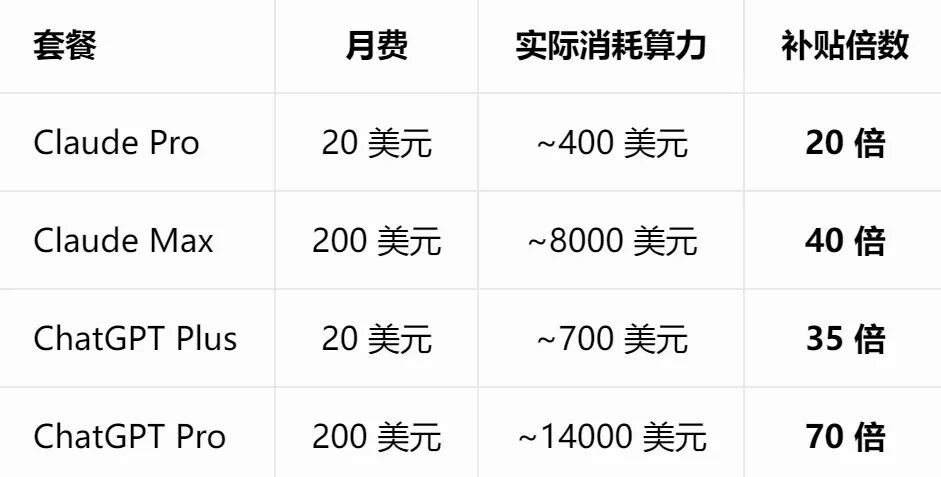
Tokens are expensive and heartbreaking. This is not only the voice of developers obsessed with Vibe Coding, but also major Silicon Valley companies have begun to implement token restrictions on their own employees. But a counter-intuitive fact is that the current Token price enjoyed by AI subscribers has been subsidized by major manufacturers to a "fracture price" - the maximum subsidy can be up to 70 times the subscription fee.
SemiAnalysis’s evaluation revealed a surprising pattern: the more expensive the package, the higher the subsidy multiple. This shows that high-end packages are not for making money, but a kind of "reverse pricing" - using the most aggressive losses to retain the most serious and ecologically valuable users. But the problem is that there are fundamental differences between AI and the Internet: Token has almost no lock-in effect. Developers can migrate API calls from one model to another in a day, and ordinary users can just change the URL. Once the subsidy stops, users can be lost instantly.
In this in-depth analysis published by Geek Park on June 21, 2026, Google Ventures founder and CEO Bill Maris quoted a pointed question on the All-in podcast: "What will happen to the business models of OpenAI and Anthropic if Google decides to cut the token price by another 80%?" Maris's answer was without hesitation: "100% will happen. Capital as a weapon, tokens as a weapon."**
Structural asymmetry: Google’s money printing machine vs. startups’ financing blood transfusion
The cruelty of this subsidy war lies in the fact that the sources of ammunition for the participating parties are completely different. Google’s annual advertising revenue exceeds $300 billion. This is not money given by investors, but a money printing machine that operates automatically every day. It uses advertising profits to subsidize AI tokens, just like a person sitting on an oil well going to fight a price war at a gas station. OpenAI has raised more than $180 billion in cumulative financing, and Anthropic has raised more than $130 billion—these are oil bought with bank loans.
DeepSeek takes a completely different route: Ultimate cost efficiency. The training cost of DeepSeek V3 is only US$5.6 million, while the benchmark US closed-source model is estimated to cost US$500 million to US$1 billion. DeepSeek V4 Pro has been permanently reduced to 1/4 of its original price, and V4 Flash is one of the most cost-effective models in the world with extremely low API pricing. When analyzing the price war pattern, the article specifically pointed out that "China has DeepSeek and Byte" - these Chinese model manufacturers have become key variables in the price war with their ultimate cost-effectiveness, fundamentally changing the anchoring benchmark of industry pricing.
"Infinite Game": No one can win, but no one can leave the table
Meituan founder Wang Xing once described a state of competition: In some competitions, there is no concept of "win". The goal of the players is not to beat their opponents, but to ensure that they stay at the table. Leaving the table is the only way to lose.
Using this framework to examine today’s AI landscape, many contradictions become clear. OpenAI's latest round of valuation exceeds 800 billion US dollars, not because it requires so much money to train the model, but to continue the price war - it needs money to "qualify to continue fighting." Google is preparing to cut prices by 80%, not to eliminate competitors, but to ensure that it remains a core player in the AI era.
From an industry perspective, there are two possible ending scenarios for the Token War. The first is the "Internet service" script - first subsidize, then monopolize, and then raise prices to harvest. However, there is almost no lock-in effect in AI, and API standardization makes switching costs approximately zero. The core conditions of this script do not hold true. The second is the "water, electricity and coal" scenario - Token becomes a standardized basic resource, competition pushes prices infinitely towards the cost line, and profit margins approach zero.
For DeepSeek, the trend of token infrastructure is both a threat and an opportunity. Business models that rely solely on API charging will face extreme price reductions, but the open source ecosystem will become the de facto standard layer for AI infrastructure, and the market share of the weighted open model will continue to expand.
Several directions worthy of attention in the future
- Google Gemini’s actual price reduction: Whether Bill Maris’ “100% will happen” will be fulfilled in the next 6-12 months will become a watershed in industry pricing
- DeepSeek commercialization path selection: Under the trend of Token freeization, how to build a sustainable business model - whether to focus on APIs or turn to vertical solutions
- OpenAI/Anthropic IPO Pricing Strategy: Pricing changes before and after listing will reveal the true cost structure of the industry, and the sustainability of Token subsidies will be scrutinized by Wall Street
- The price war tolerance of Chinese AI companies: Price reduction space and long-term sustainability of DeepSeek, Doubao, Tongyi and other models
- AI Agent’s Token Consumption Explosion: The order-of-magnitude increase in Token consumption brought about by Agent (several times that of ordinary conversations) may reshape the current pricing logic.
Reviews