Understand Langflow in one article: Focus on improving the efficiency of high-frequency tasks
Langflow's public functions, version context, cost structure, application scenarios and applicable boundaries are organized to facilitate quick evaluation of implementation value.
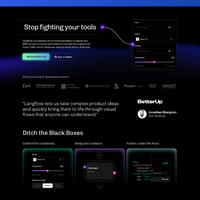 Langflow Focusing on the actual production of AI agents, Langflow focuses on improving the efficiency of high-frequency tasks, emphasizing executable processes and stable delivery. This article organizes its capability boundaries and usage points based on official documents.
Typical usage
Combined with official documents, Langflow has several types of high-frequency usage in AI agent scenarios:
- Content and Document Production: Improve the efficiency of generation, rewriting and organization.
- Knowledge Processing and Retrieval: Convert unstructured information into reusable output.
- Cross-team task collaboration: Unify entrances and processes to reduce delivery deviations.
The supporting capacity behind
- Task generation and execution: Convert natural language requirements into executable steps to improve delivery speed.
- Result Editing and Reuse: Supports secondary processing of output content and precipitated templates.
- Collaboration and Handover: Reduce cross-role communication costs and improve task closed-loop efficiency.
- Connectivity: Link with external systems in available scenarios to reduce manual transfers.
Evaluation perspective: Compare Langflow with your existing solution and focus on whether it truly reduces switching back and forth and duplication of work. This is usually more important than a single point of functionality.
Reviews