 Braintrust
Free
Braintrust
Free
Braintrust is an evaluation and observability platform for AI engineering teams. Officially positioned as "The AI observability platform for building quality AI products", Braintrust converges Eval, production tracking and prompt iteration into a set of AI programming workflow.
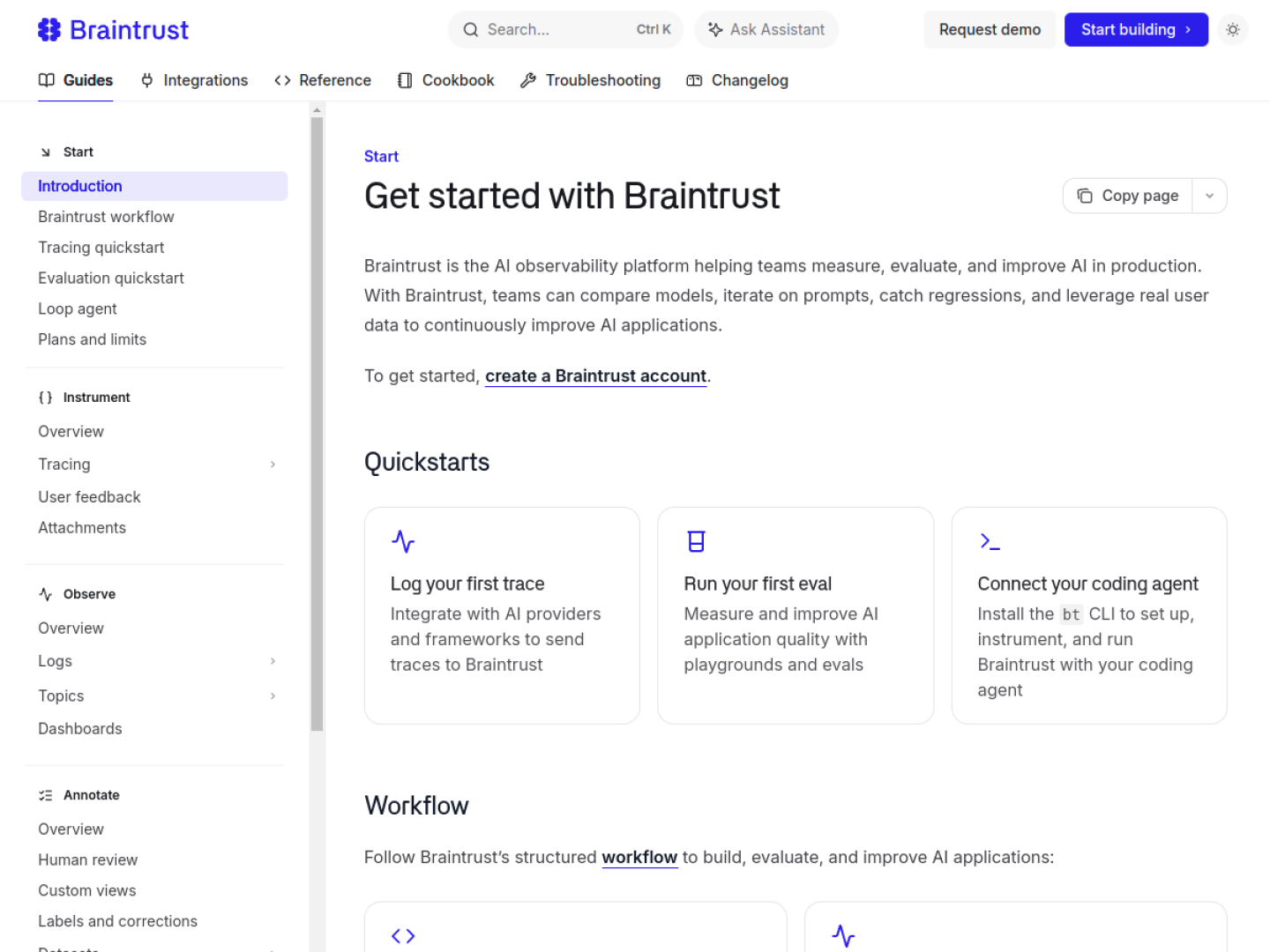
Braintrust
Core parameters and statistics
Braintrust is an evaluation and observability platform for AI engineering teams, officially positioned as "The AI observability platform for building quality AI products". The core problem it wants to solve is: the quality of LLM applications is difficult to quantify, and it is unclear whether it will get better or worse after changing a prompt or changing a model.
| Projects | Public Information |
|---|---|
| Official positioning | An observable platform for building high-quality AI products |
| Core Competencies | Eval evaluation, production tracking, prompt iteration, data set management |
| Solve problems | Quantify LLM quality changes, capture regressions before going online |
| Usage form | Web console + SDK/API access |
| Target audience | Engineering and product teams building LLM applications |
| Founder | Ankur Goyal (public information) |
| Support Platform | Web, API |
| Billing dimension | By usage/seat and function level (subject to the official website) |
Positioning difference: Braintrust is not a general monitoring, but the AI engineering process of "evaluation-tracking-iteration" is made into a product, emphasizing the use of repeatable Eval to replace "feeling-based prompts".
Access method: Connect production requests and evaluation through SDK/API, which can not only run Eval offline, but also track real traffic performance online.
Procurement Perspective: It is aimed at teams that "already have LLM applications running and are sensitive to quality regression"; it has limited benefits for projects that only do one-time demos without continuous iterations.
User and market recognition
Gradually build user awareness in the field, and product capabilities are used by content creators and teams to improve work efficiency. Some industry users have incorporated it into their daily workflow. It is recommended to refer to the latest official disclosures for specific user scale and industry adoption rate data.
Cost advantage
Braintrust's cost advantage lies not in the subscription price itself, but in replacing the hidden costs of "repeated hand testing, rollout, rollback and rework" with repeatable automated evaluation.
C-side/individuals and small teams: The official provides a free starting level, which is suitable for verifying the Eval process and access method. The free quota and functional boundaries are subject to the official website.
Developer/Team: Paid tiers are usually divided by usage (evaluation/tracking scale) and seats. The core value is to standardize the quality verification process and reduce the cost of "discovering regressions only after going online".
Enterprise/Private: Provides enterprise solutions for large-scale teams, involving SSO, authority SLA and deployment terms, which require business confirmation.
True Cost Structure: The largest hidden cost for LLM applications is "quality regression due to model/prompt changes". The value of Braintrust is in moving this type of risk forward to the evaluation stage, but only if the team invests in maintaining a high-quality evaluation set - this labor cost needs to be factored into the budget.
Main functions
Braintrust’s capabilities are designed around “making LLM application quality quantifiable, traceable, and iterable”:
- Eval Evaluation: Use the data set + scoring function to score the model/prompt output and quantify the quality change of each change.
- Production Tracing: Record the input, output and intermediate steps of real requests to locate online quality issues.
- Prompt and Experiment Management: Compare different prompts, models and parameters in a controlled environment to avoid "you have changed and you have forgotten why you changed it".
- Dataset Management: Precipitate typical use cases and boundary use cases as a factual benchmark for regression testing.
- Regression Capture: Compare historical reviews before a change goes live and find a drop in quality.
The key to functional implementation lies in the quality of the evaluation set: the closer the scoring standards are to the "right and wrong" of real business, the more credible the quality signal given by the platform will be.
Model and version evolution
Braintrust is a SaaS platform and does not disclose traditional version numbers. Its evolution is reflected in the expansion of capability stages (the precise date is not disclosed, expressed in terms of milestones):
Evaluation tool stage (early stage)
With Eval, data sets and experimental records as the core, it helps the team transform "tuning tips" from manual trial and error into repeatable experiments.
Evaluation platform stage
Integrate scoring functions, data sets, and prompt iterations into a complete workflow to support team collaboration and version comparison.
Observable platform stage (current)
The official strengthens the observable positioning of "production-oriented", connects offline Eval with online tracking, and emphasizes catching problems before the return reaches the user.
Since the platform continues to be updated on a rolling basis, the team should pay more attention to the "currently available capabilities list (scoring type, tracking granularity, integration scope)" and use the official website to check whether the target level contains the required capabilities before purchasing.
Technical advantages
Braintrust’s technical advantage comes from “productizing AI engineering” and can be broken down into three points:
Repeatable evaluation: Use data set + scoring function to turn "quality" into a quantifiable and regressable indicator, so that model/prompt changes can be based on evidence rather than subjective judgment.
Offline and online connection: It can not only run Eval in the CI stage, but also track the real traffic of production, so that "testing contextual performance" and "online performance" can be compared and analyzed.
Engineering friendly access: By embedding the existing R&D process through SDK/API, evaluation can enter the release pipeline like unit testing, reducing the risk of regression.
The price is: the platform is only responsible for "measurement and tracking", and the evaluation standards and data sets still need to be defined and maintained by the team themselves - this part of the quality determines the upper limit of the platform's value.
How to use
Braintrust uses the Web console + SDK/API as the main entrance. The typical path is as follows:
| How to use | Suitable for people | Features |
|---|---|---|
| Start for free | Personal/early project | Verify Eval process and access method |
| Team subscription | LLM application engineering team | Evaluation + tracking + collaboration, enter the release process |
| Enterprise Solution | Scaling and Compliance Team | SSO, authority SLA, business confirmation required |
Implementation is generally promoted by "Build standards → Connect to SDK → Run Eval → Track": first define the evaluation data set and scoring standards, then use the SDK to connect the application, then run Eval for each prompt/model change, and finally start production tracking to monitor online quality. The initial focus is to build a solid evaluation set, otherwise all subsequent quality signals will be unreliable.
Product Pricing
The pricing model is subject to the official real-time page. Usually a freemium or subscription system is used, and basic functions can be used for free. Advanced functions or high-frequency use require paid subscriptions, and users are advised to evaluate the optimal solution based on actual usage.
Application scenarios
Braintrust's value is focused on LLM applications that require continuous verification of quality:
- AI Product Quality Assurance: Run Eval before each prompt/model change to avoid bringing regressions online.
- RAG/Agent Tuning: Use the data set to quantify the quality of retrieval and inference, and locate which step slows down the effect.
- Production problem location: quickly locate "why this answer is wrong" by tracing and restoring the real request link.
The focus of verification in each type of scenario is the evaluation standard: the closer the standard is to the true rights and wrongs of the business, the more the quality signal can be used for decision-making.
Applicable people
- AI Engineer/ML Engineer: A team that needs to engineer LLM quality verification and incorporate it into the release process.
- AI Product Team: Pays attention to the quality of the launch and hopes to use data rather than intuition to judge the quality of changes.
- Platform/Infrastructure Team: Provide unified evaluation and observability capabilities for multiple AI functions.
Not suitable for boundaries: If the project is just a one-time demo, there is no continuous iteration, or the team is unable to maintain the evaluation data set, the value of Braintrust will be greatly reduced.
Summary and Outlook
Braintrust's core competitiveness is to productize the AI engineering process of "evaluation-tracking-iteration", so that the quality of LLM applications changes from "feeling" to "quantifiable and regressable". Its value depends on a premise: the team is willing to invest in maintaining high-quality evaluation sets; otherwise the platform can only record data and cannot judge whether it is good or bad.
The current observable uncertainties include: the precise financing and customer scale are not disclosed, the boundaries of the evaluation and tracking capabilities of each level are subject to the official website, and the ongoing labor costs caused by the maintenance of the evaluation set. It is recommended that procurement be promoted by "first using the free tier to pass the evaluation and access, and then upgrading based on data scale and seats"; the enterprise team needs to verify whether SSO, authority governance, privatization and data terms meet compliance requirements before expansion.
Related tools:  GitHub Copilot,
  Cursor
Version Info
- Braintrust AI Observability Platform :The official positioning has been strengthened into a production-oriented AI observability platform, integrating Eval, tracking and regression capture capabilities. There is no official precise date yet, please refer to the official real-time page.
- Braintrust Eval Stage :With Eval evaluation, data set and prompt iteration as the core, it helps the team quantify changes in LLM application quality. There is no official precise date yet.
- Braintrust Early Stage :Early stage of evaluation and experimental recording tool development for LLM applications. There is no official precise date yet.
User Reviews