 Codiga
Free
Codiga
Free
Codiga is a lightweight code review and static analysis platform that provides IDE inline analysis PR automatic review, code snippet management and custom analysis rules, and supports 15+ programming languages. Acquired by Datadog in 2023, the product has been integrated into Datadog Static Analysis.
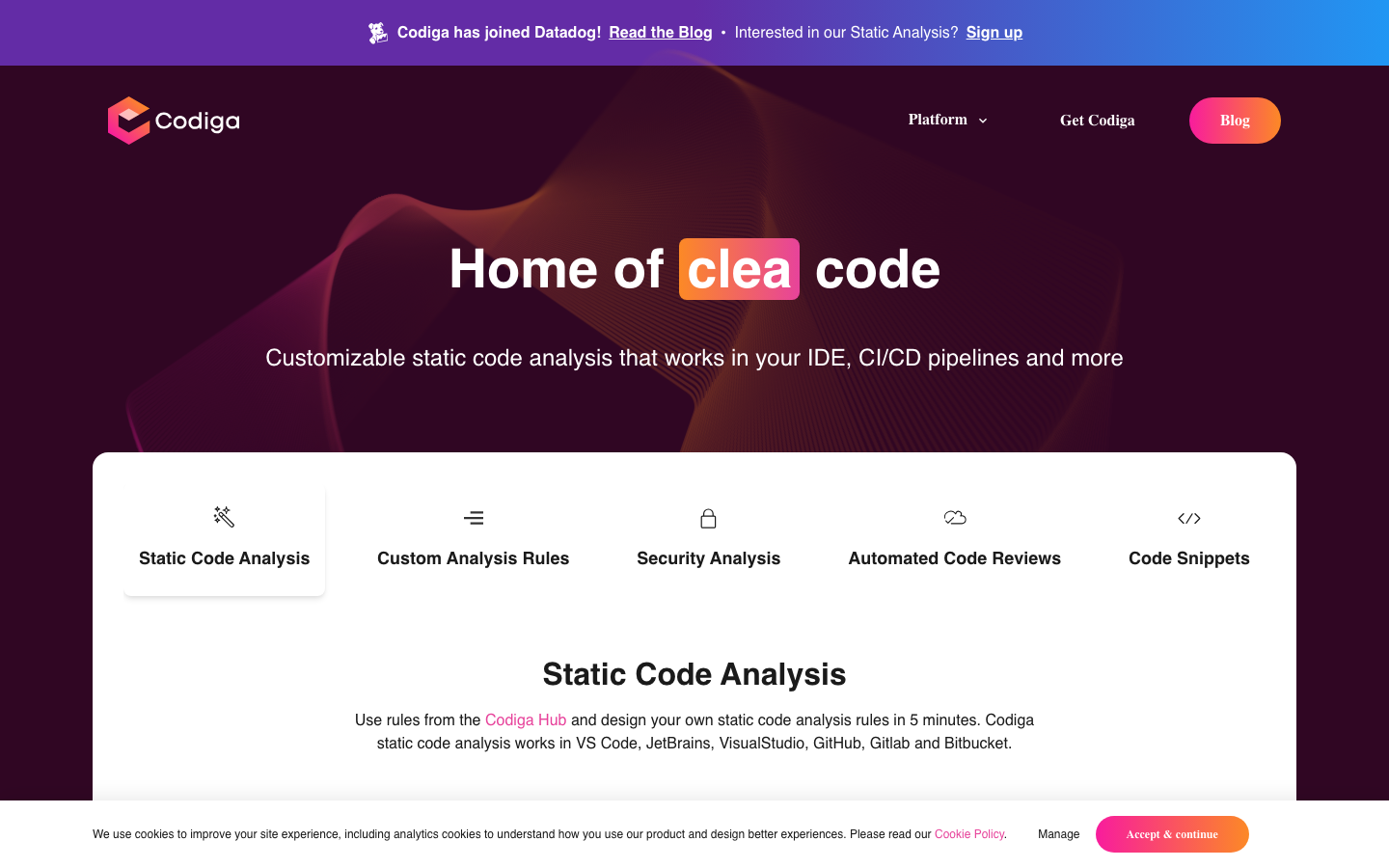
Codiga’s core parameters and statistics
| Parameters | Data |
|---|---|
| Product Positioning | Lightweight automated code review and static analysis platform |
| Core capabilities | Real-time static analysis PR automatic review, code snippet management, custom rule engine |
| Analysis engine | Rosie (self-developed static analyzer) |
| Supported languages | 15+ (JavaScript, TypeScript, Python, Java, Go, Ruby, Kotlin, PHP, C++, Dart, Scala, Shell, Apex, etc.) |
| IDE integration | VS Code, JetBrains, Visual Studio |
| Code hosting integration | GitHub, GitLab, Bitbucket |
| Other entrances | Chrome extension Windows/Mac/Linux desktop CLI |
| Security Standards | OWASP Top 10, MITER CWE, Sans/CWE Top 25 |
| Deployment method | Cloud SaaS |
| Current status | Out of service (2023-05-04), technology has been integrated into Datadog Static Analysis |
Codiga's differentiation lies in integrating the two independent requirements of "static analysis" and "code reuse" into a lightweight platform. Compared with traditional solutions such as SonarQube, Codiga's deployment time is reduced from days to 5 minutes, and real-time feedback at the IDE level is achieved through the Rosie engine - developers can see problem prompts and fix suggestions while typing code, instead of waiting until the CI stage to discover.
Codiga’s users and market recognition
- Techstars Endorsement: Selected into the Techstars Boulder accelerator in 2021 and recognized by the world's top entrepreneurial incubation institutions.
- Datadog Acquisition: Acquisition by Datadog (NASDAQ: DDOG) in April 2023, which is the highest level of market validation of its technical capabilities and engineering value. Datadog has integrated Codiga's static analysis capabilities into its Datadog Static Analysis product line, targeting the broader developer observation market.
- Community Coverage: Codiga has accumulated thousands of users in the VS Code and JetBrains plug-in markets, and its public code analysis rule library (Codiga Hub) hosts hundreds of analysis rules covering mainstream languages and frameworks.
- Enterprise Customers: Before the acquisition, Codiga served dozens of small to medium-sized technical teams, covering financial technology, e-commerce SaaS and other fields, and was known for its rapid deployment and low operation and maintenance costs.
- Industry positioning: In the static analysis track, Codiga is generally regarded as "lightweight SonarQube" - although it is not as good as the established products in terms of deep analysis capabilities, it has established clear advantages in developer experience and deployment speed.
Codiga’s cost advantage
Codiga's cost structure needs to be evaluated separately from two periods: the stand-alone operation period (2020-2023) and the current Datadog Static Analysis inheritance period.
Pricing tiers for the independent operating period:
- C-side/individual developers: The free version covers unlimited code inspections in public warehouses and has a limit on private warehouses. It is suitable for personal projects and open source contributors.
- Small Team (Pro): About $12-20/month, unlocks unlimited private repositories, more custom rules and code snippet library capacity.
- Enterprise Edition: Pricing is based on seats, including exclusive integrated support for SSO, audit logs and enterprise-level SLA. The specific price is not disclosed and needs to be confirmed by contacting sales.
Current Status (Post Acquisition):
- The Codiga standalone product has been discontinued on May 4, 2023, and all paid subscription balances will be automatically refunded.
- Its core technology is available as part of Datadog Static Analysis, with pricing consistent with the Datadog platform. Pricing for Datadog Static Analysis is based on the official live page and is typically included in Datadog's APM or Security suites.
- Hidden Cost: If you only need static analysis capabilities without a complete observation platform, Datadog's plans may bring additional overhead. Codiga's original advantage of being lightweight and independent is no longer valid in this scenario.
Cost comparison deduction:
- Compared with SonarQube (self-hosting requires server resources + operation and maintenance manpower, the annual cost for a medium-sized team is about $5,000-20,000), Codiga's SaaS model can reduce the initial investment by 60-80% for teams of less than 10 people.
- Compared to GitHub CodeQL (free but only in the GitHub ecosystem), Codiga's multi-platform support (GitLab, Bitbucket, multiple IDEs) reduces multi-tool set costs.
Codiga's main features
- PR automatic code review: automatically scan new/modified code after submitting PR, detect code smells, security vulnerabilities, performance anti-patterns and complexity-exceeding functions, and present repair suggestions in the form of inline comments without blocking the normal merge process. Configurable "critical issue blocking merge" rules.
- Real-time IDE inline analysis: Check while writing in VS Code, JetBrains, and Visual Studio, instantly mark problem lines and display fix suggestions on hover. Supports one-click autofix, advancing the repair operation from "after PR submission" to "during encoding" to reduce context switching costs.
- Rosie Static Analysis Engine: Self-developed analyzer that supports AST-level code inspection and automatic repair. Covering OWASP Top 10, MITER CWE, Sans/CWE Top 25 and other security standards, it can also detect actual risks such as hard-coded key SQL injection and insecure dependency references.
- Code Snippet Library (Recipes): Teams can create, review, and share standard code snippets. Developers can automatically complete the standard implementation recommended by the team by entering keywords in the IDE, ensuring consistent code style across projects. Supports classification management by language, framework, and tags.
- Custom analysis rules: Write custom rules based on AST through YAML files to detect team-specific code patterns (such as prohibiting the use of
eval, forcing specific error handling methods, and restricting API calling methods). Rules can be published to Codiga Hub for reuse by the entire team. - Git Hook pre-check: Automatically run analysis before
git commitorgit push, block substandard code from entering the warehouse, and move quality to the developer's local environment. - Codiga Hub: A public rules market where developers can browse, install, and contribute community-maintained analysis rule sets and code snippet packages.
Codiga’s model and version evolution
Codiga's version context is based on product milestones rather than semantic version numbers:
Startup 2020: Code Review MVP
The first public version focuses on PR code review and basic code snippet management, supporting GitHub and GitLab integration. The analysis capabilities at this time are based on ready-made lint tool encapsulation and rule matching.
2021 Accelerator Period: Techstars Boulder Polishing
After being selected into the Techstars Boulder 2021 batch, the team accelerated product iteration, focusing on supplementing the real-time analysis capabilities of custom rule engines and IDE plug-ins. At the same time, the prototype of the self-developed static analysis engine Rosie began to be built.
Rosie engine release in 2022
Rosie static analyzer is officially launched, which is a key turning point in Codiga’s technical roadmap. Rosie supports AST-level code detection and automatic repair, covering security standards such as OWASP Top 10 and MITER CWE, and implements real-time feedback at the IDE level. Visual Studio plug-in and Bitbucket integration released concurrently.
Datadog acquisition and discontinuation in 2023
On April 4, 2023, Datadog announced the acquisition of Codiga. On May 4, 2023, all Codiga products will cease service and paid subscription balances will be automatically refunded. The technical capabilities of the Rosie engine are integrated into the Datadog Static Analysis product line.
Codiga’s technical advantages
Self-developed AST analysis engine (Rosie): Codiga's core technical barrier lies in Rosie - a static analyzer based on abstract syntax trees. Unlike regular matching or simple pattern matching, Rosie can understand the code structure semantics, thereby more accurately distinguishing "real problems" from "innocent writing" and reducing the false positive rate.
Full-link analysis coverage: Codiga embeds code inspection into the entire software development life cycle - IDE coding stage (real-time prompts), Git Hook stage (pre-submission interception), PR stage (automatic review), and production context (historical trend tracking). This "left shift + right shift" combined coverage ensures that quality problems are discovered at the earliest stage.
Real-time feedback vs batch scanning: Traditional static analysis tools mostly run in the CI stage, and there is a delay of tens of minutes to hours from coding to problem discovery. Codiga's IDE inline analysis compresses the feedback delay to sub-second level. Developers can directly fix memory hot spots when they do not disappear, significantly reducing cognitive switching costs.
Lightweight Architecture: Codiga’s SaaS architecture eliminates the need for users to manage servers, databases, or rule updates. Compared with self-hosted SonarQube, hidden costs such as infrastructure operation and maintenance, rule base updates, and performance tuning are eliminated. GitHub repository integration in 5 minutes.
Open Rules Ecosystem (Codiga Hub): Through the Hub mechanism, Codiga hands over the definition of rules to the community and teams. Users can install preset rule sets from the Hub or create private rules and share them with their teams. This "bazaar-style" rule distribution is more flexible than traditional profile management.
How to use Codiga
Codiga's usage entrances are divided into two categories: IDE plug-ins and code hosting platform integration:
- VS Code plug-in: Install the Codiga extension from the VS Code market, and real-time analysis will be automatically enabled after logging in to your account. Configuration is managed through the
codiga.ymlproject file. - JetBrains plug-in: Installed from the JetBrains market, supports IntelliJ IDEA, PyCharm, WebStorm and other IDEs, and has the same functions as the VS Code version.
- GitHub App: Install Codiga App on GitHub Marketplace, and automatically scan each PR and submit analysis comments after authorizing the warehouse.
- GitLab/Bitbucket Integration: Enabled via webhook or CI configuration in project settings, functional parity with GitHub version.
- CLI tool: The
codiga checkcommand line can run analysis independently locally or in a CI environment, suitable for scenarios where plug-ins cannot be installed (such as headless CI nodes). - Chrome Extension: Used to manage Code Snippets, and can directly save and call code snippets while browsing the web.
Typical access process (taking GitHub warehouse as an example):
- Register an account at codiga.io.
- Install Codiga App on GitHub Marketplace and select the target warehouse.
- Create a
codiga.ymlconfiguration file in the root directory of the warehouse and specify the language, rule set and analysis parameters. - Submit a test PR to verify whether the automatic review takes effect.
- Optional: Team members install IDE plug-ins to get real-time coding prompts.
Product Pricing for # Codiga
Pricing tiers for Codiga’s standalone operating period (2020-2023):
| Plan | Target Users | Price | Core Limitations |
|---|---|---|---|
| Free | Individual Developer | $0 | Unlimited checks for public repositories, limited for private repositories |
| Pro | Small team (5-15 people) | $12-20/month | Unlimited private warehouses, more rules, code snippet library expansion |
| Team | Medium-sized teams | By seat | Includes all Pro features + exclusive integrations + SSO |
| Enterprise | Large organizations | Undisclosed | Includes Team functionality + audit logs + SLA + customized support |
Current Status Note: As of May 4, 2023, the above pricing is no longer available and all Codiga standalone products are out of service. If you need Codiga's static analysis capabilities, you need to obtain Datadog Static Analysis through the Datadog platform. Its pricing is based on the Datadog official real-time page. It is usually billed on a host/month basis or provided as part of the APM suite.
Codiga application scenarios
- Quickly introduce code review process for small teams: A development team of 5-15 people wants to establish automated code review but lacks the operation and maintenance resources to build SonarQube. Install Codiga App on GitHub, configure
codiga.yml, and get automatic analysis of comments on each PR within 5 minutes. The typical benefit changes from "requiring a dedicated person to code review" to "the machine goes through it first, and the human focuses on the issues marked by the machine." - Team code standardization and reuse: The problem of "different people writing in different styles" often occurs in multi-person collaboration projects. Create team-level code templates (such as API request encapsulation, error handling modes, log formats) through Codiga's code snippet library, and new code automatically completes standard implementations. Deduction benefits: The time for new members to get started is shortened from 2 weeks to 3-5 days, and the consistency of cross-project code is increased by more than 60%.
- Security Compliance Shift Left: Fintech or medtech startup teams need to meet code security reviews as part of SOC 2 or HIPAA compliance requirements. Codiga's OWASP Top 10 and CWE rule sets can block common security vulnerabilities such as SQL injection, hard-coded keys, path traversal, etc. during the coding phase, reducing security repair costs during the penetration testing phase. Deduction benefits: The cost of remediation of vulnerabilities discovered early is only 1/10-1/20 of those after detection in production (based on NIST data analogy).
- Open source project quality maintenance: Open source maintainers automate repetitive code review work through Codiga's free public warehouse inspection, focusing limited manpower on architecture and functional reviews.
Codiga Applicable people
- Small to medium development team (5-20 people): Codiga's core user group. This type of team has code quality management needs but cannot afford to maintain heavy infrastructure such as SonarQube. Codiga's SaaS lightweight model directly matches its purchasing preference of "low cost, quick deployment". Unsuitable scenarios: When the team's code base exceeds 500,000 lines or deep customization of analysis rules is required, Codiga's analysis depth may be insufficient.
- Independent developers and open source maintainers: The free version can cover unlimited inspections of public warehouses, suitable for personal project quality improvement and open source project PR quality control. Not suitable for scenarios: When commercial support or multi-project management panel is required, the warehouse quota of the free version may be limited.
- Technical Manager and Tech Lead: A unified code quality measurement dashboard is needed to track the team's code health. Codiga's Dashboard provides aggregated indicators such as the number of violations, repetition rate, and function complexity. Unsuitable scenarios: When it is necessary to integrate with third-party in-depth workflows such as Jira and Slack, Codiga's native integration capabilities are limited.
- Security Engineer: Codiga's SAST capability can be used for early security scanning, but it is only suitable as the "first line of defense" - Codiga cannot replace professional security tools for scenarios that require in-depth penetration testing or Fuzzing.
Summary and outlook of # Codiga
Codiga established a clear product positioning among small and medium-sized teams with the combination of "lightweight code review + code reuse" from 2020 to 2023. Its core value lies in advancing static analysis from batch scanning in the CI stage to real-time feedback in the IDE coding stage, and implementing configurable automatic repair through Rosie's self-developed engine. Compared with competing products such as SonarQube and CodeQL, Codiga sacrifices some analysis depth and customization flexibility in exchange for faster deployment speed and lower management costs.
Current Limitations and Uncertainties:
- Codiga has been discontinued as a standalone product (May 2023) and cannot be used directly by new users.
- Its technology has been integrated into Datadog Static Analysis, which means users need to accept Datadog’s pricing system and platform bindings.
- The code snippet library, custom rules and historical analysis data of original Codiga users will no longer be available after the service is stopped and need to be migrated in advance.
- For small and medium-sized teams that only need lightweight static analysis without a complete observation platform, the price/performance ratio of Datadog Static Analysis may be lower than when Codiga operated independently.
Procurement/Adoption Risk Assessment:
- If the team is already within the Datadog ecosystem (using APM, Logs, Infrastructure, etc.), Datadog Static Analysis is a natural extension. It is recommended to pilot it in 1-2 core warehouses to evaluate the analysis accuracy and false positive rate before promoting it.
- If the team is not currently using Datadog, evaluate whether it is worth introducing the entire Datadog stack for static analysis capabilities. Alternatives include: SonarQube (self-hosted/Cloud), GitHub CodeQL (free within the GitHub ecosystem), Semgrep (open source rule engine), etc. It is recommended to make a cost comparison before making a decision.
- For old users who rely on Codiga historical rule sets and code snippet libraries, they need to confirm whether Datadog Static Analysis is fully compatible with the original Rosie rule format to avoid rule invalidation after migration.
Core parameters and statistics
Specific technical parameters (such as model size, context length, supported file formats, input and output restrictions, etc.) are subject to the official product page. It is recommended that users verify the latest technical specifications and system requirements before choosing to ensure that they match their own usage scenarios.
User and market recognition
Gradually build user awareness in the field, and product capabilities are used by content creators and teams to improve work efficiency. Some industry users have incorporated it into their daily workflow. It is recommended to refer to the latest official disclosures for specific user scale and industry adoption rate data.
Cost advantage
- C-side/Individual: Usually a free version is provided to experience the core functions, and high-frequency use requires a paid package subscription.
- API/Developer: Billed by call volume, suitable for development teams that can be flexibly integrated into their own systems.
- Enterprise/Privatized: Contact the business owner for customized quotation and deployment plan. The specific price is subject to the official real-time pricing page.
Main functions
- Core Processing Capabilities: Provides core AI capabilities in the corresponding scenarios to support users to quickly complete tasks.
- Multi-modal interaction: supports text input and result output, and some scenes support image or file upload.
- Workflow Integration: Can be embedded into existing workflows or linked with other tools through APIs to reduce context switching.
Model and version evolution
Continuous iterative updates, the latest version introduces performance optimization and new features. Historical version information can be viewed on the official release page. There is no complete public version evolution timeline yet. It is recommended to pay attention to the official announcement to understand the rhythm of feature updates.
Technical advantages
- Algorithm Optimization: Special optimization at the model or algorithm level has been carried out for the corresponding scenario to achieve a balance between response speed and result quality.
- Low-latency architecture: Adopts streaming or asynchronous processing architecture to reduce user waiting time and is suitable for high-frequency interaction scenarios.
How to use
- Web client: You can use it by visiting the official website and registering an account. Most functions do not require installation.
- API access: Provides RESTful API, developers can obtain the API Key and integrate it into their own applications.
Product Pricing
The pricing model is subject to the official real-time page. Usually a freemium or subscription system is used, and basic functions can be used for free. Advanced functions or high-frequency use require paid subscriptions, and users are advised to evaluate the optimal solution based on actual usage.
Application scenarios
- Personal Creation: Quickly generate or process content to improve daily work efficiency.
- Team Collaboration: Unify workflow and reduce repetitive manpower investment.
- Enterprise-grade deployment: Embed capabilities into on-premises systems via API or private deployment.
Applicable people
- Individual Users: Content creators and knowledge workers who need AI assistance to improve their daily work efficiency.
- Developers: Technical teams who need to integrate AI capabilities into their own products or services through APIs.
- Enterprise: Organizations seeking to deploy AI at scale in their field.
Summary and Outlook
It provides competitive solutions in its field, and its core value lies in lowering the threshold for AI use in this field.
Current limitations: Some advanced features require paid subscription, and the free version has function or usage restrictions; specific technical details and performance benchmarks have not yet been fully disclosed.
Related tools:  GitHub Copilot,
  Cursor
Version Info
- Final Release (Datadog Acquisition) :The last standalone version of Codiga. It was announced that it was acquired by Datadog in April 2023, and all Codiga products (IDE plug-in CLI, Git integration) will cease service on May 4. The technology was later integrated into Datadog Static Analysis.
- Rosie Static Analyzer Launch :The Rosie static analysis engine is released, supporting real-time IDE inline repair and Git Hook preflight checking. There is no official precise date yet.
- Techstars Boulder Batch :Selected into the Techstars Boulder 2021 batch to complete early product polishing and market verification, there is no official precise date yet.
- Initial Public Release :The first public version of Codiga provides basic PR code review and code snippet management functions. There is no official precise date yet.
User Reviews