 Grok
Grok
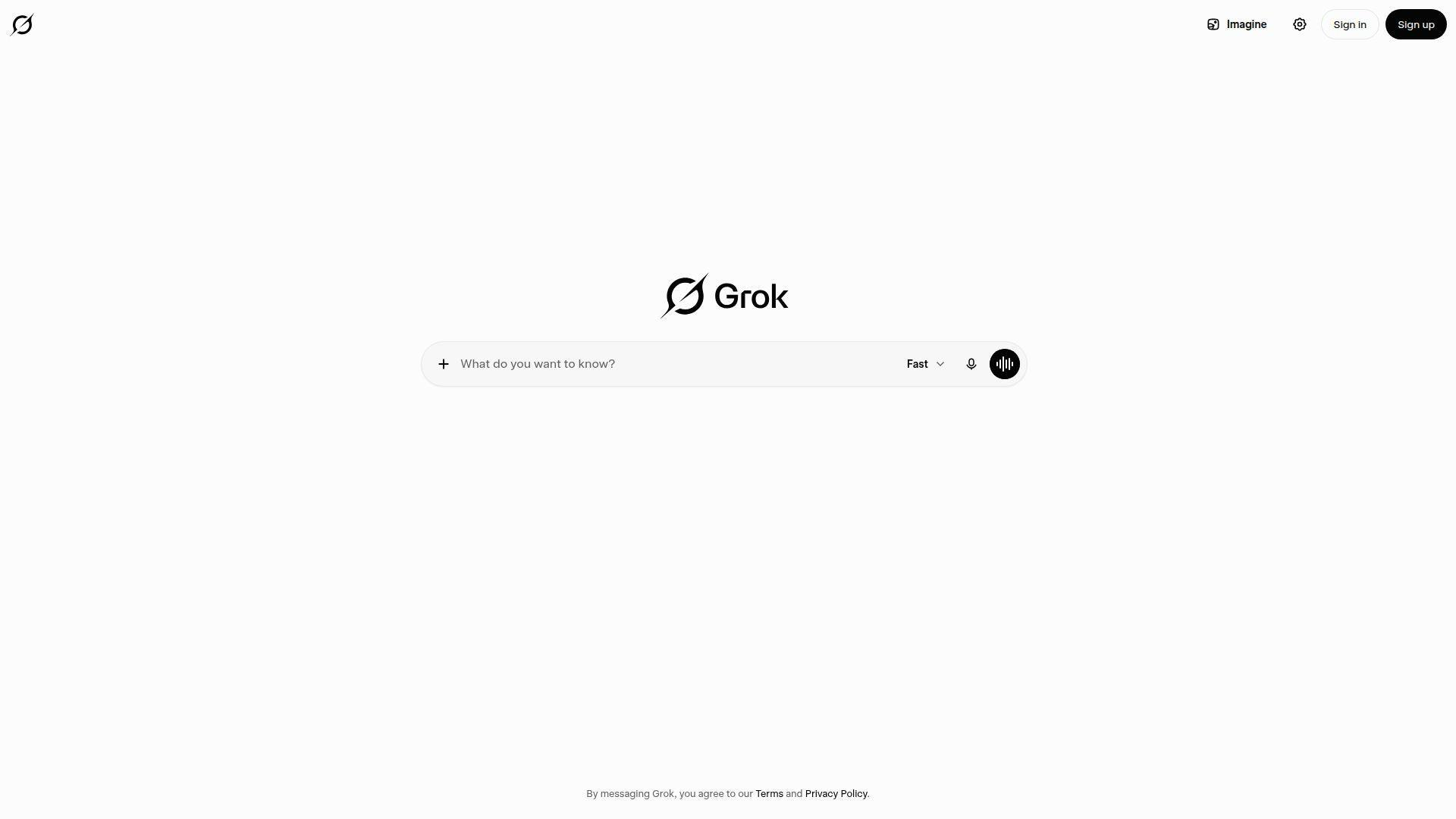
Grok is a AI chat tool created by xAI. It deeply integrates real-time data from the X platform and provides capabilities such as Grok 4 inference DeepSearch and Imagine multi-modal generation.
grok
Grok’s core parameters and statistics
Grok was built by Elon Musk's xAI and is positioned as a multi-modal AI chat assistant. The core difference lies in the three-in-one capability stack of real-time X platform data directly connected to the Grok 4 inference engine and Imagine multi-modal generation. It is not another variant of a general conversational robot, but a product that compresses "social pulse monitoring + strong reasoning + visual generation" into the same dialog box.
| Parameters | Public information |
|---|---|
| Flagship model | Grok 4, special enhancements for reasoning, coding, and mathematics |
| Multimodal generation | Imagine module: text image + up to 6 seconds of 1080p video |
| Real-time data | Direct connection to the X platform for access to real-time posts, trends, news |
| Search capability | DeepSearch multi-step network search + Think reasoning mode |
| Context window | The exact value is not disclosed (officially not disclosed), it is recommended to pay attention to the actual performance in long dialogue scenes |
| Terminal coverage | Web grok.com, iOS, Android, X built-in entrance |
| Free quota | About 10 tips / 2 hours; image analysis 3 times / day |
| Subscription Tiers | Free → SuperGrok ($30/month) → Premium+ (~$50/month) → Enterprise API |
Positioning boundaries: Grok is good at "reasoning and creation based on the latest social signals", rather than static knowledge base question and answer or serious academic literature retrieval. It has obvious advantages in scenarios such as emergency event discussion, social media sentiment analysis, and hot comment generation. However, when in-depth domain knowledge is required (such as medical diagnosis, accurate citation of legal provisions), its reliability is not as reliable as special tools or models that have been fine-tuned in the field.
Real experience with free quota: The Free tier has a quota of about 10 messages/2 hours, which is mainly used for short conversation experience and function evaluation. Compared with  ChatGPT Free's unlimited basic conversations, Grok's free tier is closer to a "trial version" - suitable for verifying model style and response quality, but cannot be used as a daily main tool for long-term use. Heavy users will almost certainly need to jump into SuperGrok or Premium+.
Comparative vision: Compared with Perplexity, Grok's real-time data source focuses more on the X social graph rather than the entire network search, which makes it sharper on social media topics, but less broad in multi-source fact cross-validation. Compared with  Gemini, Grok's multi-modal generation (Imagine video) is its unique selling point, but Gemini's deep integration in the Google ecosystem (Gmail, Drive, Search) is still its irreplaceable moat.
Grok’s users and market recognition
Grok's market recognition radiates outward from the center of the X platform, showing the characteristics of "high viscosity within the platform and gradual penetration outside the platform".
In-platform bonus distribution: Grok is naturally built into the X client. When users browse the timeline, they can directly call Grok to explain posts or generate replies. This entrance is the core engine for its user growth. X management has publicly mentioned on many occasions that Grok's traffic contribution has become a key driving force for X Premium renewals - users subscribe to Premium+ for Grok, not to remove ads or other features. This "model-driven subscription" model is the first of its kind among social media platforms.
Industry Benchmark Performance: xAI publicly claims that Grok 4 ranks at the forefront of many hard-core benchmarks at the time of release, such as HMMT (Harvard-MIT Mathematics Competition), AIME (American Invitational Mathematics Examination), GPQA (Graduate Level Science Questions and Answers), and is close to or exceeding the closed-source flagships of the same period. In the public lists of third-party evaluation communities (such as Artificial Analysis, LMSYS Chatbot Arena), the Grok series maintains high rankings in the dimensions of reasoning and mathematics, but there is a clear gap with  Claude in the dimensions of "world knowledge" and "long-form creation".
Media and Industry Attention: Mainstream technology media such as The Verge, Bloomberg, and TechCrunch continue to track Grok’s version iterations and its controversial content strategy. Under the banner of "pursuing the truth to the greatest extent", xAI takes a more relaxed stance on content review than other mainstream models. This not only attracts user groups dissatisfied with "politically correct filtering", but also brings about ongoing disputes about brand safety and compliance. As of now, no authoritative third party has released independently audited data on Grok’s global MAU or paying user numbers.
B-side penetration is still in the early stages: Unlike OpenAI’s deep layout in enterprises, xAI’s enterprise API and privatization solutions are still in their infancy. At present, Grok's main commercial value is reflected in C-side subscription revenue and the pulling effect on X Premium. Real enterprise-level implementation cases and industry solution ecosystem have yet to be built.
Grok’s Cost Advantage
Grok's cost structure revolves around "direct subscription + X ecological bundling", which follows a different monetization logic from competing products.
C-side/individual users: Free tier allows entry at zero cost, but the quota is strict (about 10 items/2 hours) and is only for functional verification. SuperGrok ($30/month) is a recommended node for individual heavy users and provides high-limit Grok 4, DeepSearch and Imagine image generation. Compared with ChatGPT Plus (about $20/month), SuperGrok is 50% more expensive, but it has more social real-time data and Imagine image generation capabilities. Premium+ (approximately $50/month) packages Grok 4 video generation with X platform premium benefits. For X-heavy creators, Grok video capabilities are equivalent to being "included" in an X subscription.
| Plan | Price | Grok Rights | Applicable Scenarios |
|---|---|---|---|
| Free | $0 | Basic Grok, about 10 items/2 hours, 3 image analyzes/day | Experience, light Q&A |
| SuperGrok | $30/month | Grok 4 + DeepSearch + Imagine images, priority response | Personal heavy use |
| Premium+ | ~$50/month | Grok 4 + Imagine video + X platform premium benefits | X creator, social media operation |
| xAI API | Pay-as-you-go billing | Model access, enterprise SLA (business communication) | Developers and enterprises |
Developer/API Cost: The pricing of xAI API is not fully disclosed and needs to be obtained through business communication. Compared with OpenAI API or Anthropic API, xAI's API ecosystem is still in its early stages, and key information such as available model options, frequency control limits, and data residency terms are less transparent. Enterprises need to take the "sourcing cost" and "docking cycle" of APIs into implicit cost considerations when selecting.
Enterprise/Private Cost: xAI does not currently offer on-premises or privatized options publicly. If an enterprise needs to use Grok capabilities in a compliance context, the main channel is still API. The audit chain of data processing and the privacy compliance of model output must be clearly agreed in the contract. In addition, Grok's lax content review policy may bring additional compliance review costs in highly regulated industries such as finance and medical care.
Hidden Cost Tip: Grok's free quota is reset based on time periods rather than prepaid according to usage, which means that it is easy to encounter the embarrassment of insufficient quota during intermittent heavy use. Premium+ subscription is "approximately $50/month" due to regional and exchange rate fluctuations, and the actual deduction is subject to the real-time price of the X platform.
Grok’s main functions
Grok's functional architecture revolves around three closed links of "real-time perception → deep reasoning → multi-modal output". It is not the stacking of single capabilities, but the mutual enhancement of functions.
- Grok 4 Inference Engine: Long context reasoning, code generation, math and science Q&A. Synergy effect: The inference results can be directly passed to Imagine to generate visual charts, or supplemented with real-time data support through DeepSearch, achieving a seamless transition from "thinking clearly" to "presenting clearly".
- DeepSearch multi-step search: Automatically perform multiple rounds of online searches on a topic, integrate multi-source information and then output a structured research report. Usage Tips: Suitable for investment research, competitive product analysis, event tracking and other scenarios that require systematic information aggregation. The depth and breadth of retrieval can be adjusted through questioning, but the response time is significantly longer than that of a single round of question and answer.
- Think reasoning mode: Switch the model to the "thinking-verification" link, suitable for tasks that require explicit reasoning paths such as mathematical proofs, logic puzzles, and multi-step planning. Implementation Note: The amount of tokens output by Think mode increases significantly, and the cost of dialogue increases accordingly. It is recommended to enable it only in scenarios where the inference chain is really needed.
- Imagine image generation: Text to image generation, supporting multiple art styles and editing operations (redraw, expansion, local modification). Compared with dedicated tools such as
 Midjourney, the advantage of Grok's Imagine lies in its integration with the chat context - when talking about a topic, pictures can be generated instantly without switching tools.
 - Imagine Video Generation: Up to 6 seconds of 1080p video for SuperGrok and Premium+ users. Current limitations: Video length and controllability (such as precise camera movement, character consistency) still have obvious limitations. It cannot replace professional video editing tools and is more suitable for quickly producing short video materials or dynamic demonstrations.
- Real-time X data integration: Instantly reference the latest posts, trending topics, and news headlines on X. This is Grok's most differentiated ability - when discussing an ongoing event on the X platform, Grok can quote posts "a few seconds ago" as
This is a qualitative improvement in the timeliness requirements for public opinion research and hot content.
- Voice dialogue and personality switching: iOS/Android supports low-latency voice dialogue; a variety of built-in chat roles can be switched between "standard mode" and "uncensorship mode". Risk Boundary: The non-censorship mode may output content that is filtered on other platforms. Users need to evaluate the legal compliance requirements in their region.
- Image Understanding and Analysis: After uploading the image, analyze it, solve math problems, and extract OCR text. When combined with DeepSearch, a complete link of "identification→retrieval→interpretation" can be performed on a physical image.
Grok’s model and version evolution
Grok's version iteration has lasted about 18 months from the end of 2023 to the present, and has experienced a transition from "X affiliated chat experiment" to "independent multi-modal platform".
Mainline release
- Grok 1 (2023-11-04): The first public version of xAI. Positioned as an X built-in assistant with a good sense of humor and the courage to answer "spicy questions", it is only available to X Premium+ subscribers. At that time, Grok 1 was more like a technical demo, and its core value was to verify the product direction of "social data + chat".
- Grok 2 + Aurora (2024-08-13): Major architecture upgrade, introducing multi-modal capabilities and Aurora image generation, fully integrating X platform search and news. Aurora is xAI’s first attempt at visual generation, laying the foundation for subsequent Imagine modules. Grok 2 is starting to enter the mainstream with lists like LMSYS Chatbot Arena.
- Grok 3 + DeepSearch (2025-02-17): Launch DeepSearch and Think modes, upgrade Grok from "chat assistant" to "research assistant". DeepSearch's multi-step search capabilities make it directly comparable to Perplexity in information integration scenarios. xAI will also open Grok 3 to Premium+ users for free to expand its user base.
- Grok 4 + Imagine (2025-07-09): Current flagship version. Greatly improve reasoning and mathematical capabilities, the accompanying Imagine module supports image and 1080p video generation of up to 6 seconds. This is the first time that Grok covers the complete "understanding → reasoning → generation" capability range, marking xAI's transformation from a single-point chat tool to a multi-modal AI platform.
Version strategy observation
xAI's version naming follows the paradigm of "large version number + capability module name" (Grok 3 + DeepSearch, Grok 4 + Imagine), rather than OpenAI's "GPT-4o → GPT-5" or Anthropic's "Claude 3 → Claude 4". This naming method allows each version to have a clear memory point for capabilities, but it also increases the complexity of version evolution tracking - "Grok 4" itself contains independent updates of multiple sub-modules.
Current version and follow-up rhythm
The latest subversion of Grok 4 is grok-4-imagine (2025-07-09). xAI has not disclosed timelines and capability targets for the next version (Grok 5?). Judging from the official release rhythm of xAI, Grok’s iteration cycle is about 6-9 months with a major version upgrade, interspersed with small version optimization and module expansion. Follow-up focus includes: the official parameter caliber of long context capabilities, the continued improvement of multi-modal generation (video length and controllability), and the maturity of the xAI API ecosystem.
Grok’s technical advantages
Grok's technical advantages do not come from the perfection of a single dimension, but from the triangle of "data source + inference engine + distribution channel".
Real-time data pipeline: Grok is directly connected to the real-time data stream of the X platform, which is an exclusive data pipeline among mainstream AI assistants. When a user asks "What just happened on X", Grok does not search in the static corpus, but directly queries the real-time index of X. The engineering cost of this architecture is that Grok's responsiveness is limited by the latency of the X data pipeline, and Grok's real-time capabilities are degraded when the X platform itself fails or becomes congested. Furthermore, relying on a single social data source means that Grok's "fact base" is inherently limited by the quality of content in X's community - what's popular on X does not equal truth or comprehensiveness.
Reasoning and Mathematical Ability: Grok 4’s performance on HMMT, AIME, GPQA and other benchmarks shows that xAI invests a lot of resources in inference optimization. Its technical route is similar to OpenAI’s o series and DeepSeek’s R series—strengthening the model’s chain reasoning capabilities through reinforcement learning (RL) post-training. The difference is that xAI started late in large-scale infrastructure, and specific data on the size and usage efficiency of the training cluster have not been made public. This leaves the outside world with a lack of verifiable evaluation basis for the "cost-effectiveness" (inference quality per unit of computing power output) of Grok 4's inference capabilities.
Imagine multi-modal generation: Integrating image and video generation in one model is not a simple stitching of features. xAI implements the contextual continuation of "inference → generation" in Grok 4 - the model can directly output relevant visual content after reasoning about a concept, without the need to copy and paste prompt words between different tools. This "thinking-visual" coherence is Imagine's differentiating value relative to stand-alone imaging tools. However, there is still a perceptible gap between Imagine and professional tools such as Midjourney and DALL·E in terms of image quality, style diversity and prompt compliance.
X Ecological Distribution Advantage: This is the most difficult moat for competing products to copy. Grok is embedded directly into the X client, which means it has a default entry point for hundreds of millions of active users. Compared with ChatGPT, which requires users to actively open a website or app, Grok's usage scenario is more "passive" - it is triggered naturally when users browse the timeline. The quantitative effect of this distribution efficiency is reflected in the X Premium renewal rate and the boost to the overall retention time of the X platform.
How to use Grok
Grok provides four main usage paths, covering a complete spectrum from zero-threshold chat to developer integration.
| Entrance | Adaptable Crowd | Core Competencies | Fees |
|---|---|---|---|
| Web grok.com | All users | Full chatDeepSearch, Imagine images | Free / SuperGrok |
| iOS / Android App | Mobile Users | Voice Conversation, Image Analysis Imagine Video | Free / SuperGrok / Premium+ |
| X client built-in | X active users | Timeline context understanding, post comment generation | Premium+ |
| xAI API | Developer | Model embedding, custom workflow | Pay-as-you-go billing (requires business) |
Typical usage process: Select the model level (Standard/Think/DeepSearch/Imagine) on the web → Enter a question or upload a picture / Paste the X link → Grok outputs the answer and attaches the X real-time reference → Export with one click or continue to ask. Within the X client, users can summon Grok directly under any post to explain the content, generate replies, or analyze the context of the discussion.
API access tip: The endpoint, model list and authentication method of xAI API need to be confirmed through xAI official documentation. As of now, the public documentation and SDK support of xAI API are still not as mature as OpenAI/Anthropic, and developers need to reserve additional integration debugging time when selecting.
Human-machine collaboration boundary: Grok can reach a high level of automation (80%-90%) in information summarization, creative dissemination, social media content generation, etc. However, it is recommended to set up manual confirmation points in the following areas:
- Fact Check: Grok's references to X data may contain unverified rumors or posts taken out of context and require manual cross-verification before critical decisions are made.
- Content Publishing: Grok-generated posts or comments published on social platforms. It is recommended to conduct compliance checks and tone adjustments before publishing.
- Sensitive Data Processing: The conversation content entered by enterprise users into Grok may be used for model improvement (xAI data usage policy is subject to the latest official version), so caution is required when involving private information.
Grok’s Product Pricing
Grok's pricing system adopts a hybrid model of "free trial + multi-level subscription + X ecological bundling". The three-tier structure serves users with different decision-making links.
C-side/Personal Subscription: The Free tier is the entrance to functional experience, but the limit of 10 items/2 hours means that it is only used for "taste testing". SuperGrok ($30/month) is the main plan for heavy individual users, offering high-limit Grok 4, DeepSearch and Imagine images. Premium+ (~$50/month) is best suited for X creators—it not only includes the full capabilities of Grok (including Imagine videos), but also packages the X platform’s value-added benefits of ad relief, priority support, and long-form tweets.
Developer/API call: The xAI API is currently mainly for enterprise customers communicating through business, and the public pay-as-you-go billing standards are limited. Compared with OpenAI's out-of-the-box API, the xAI API is less self-service and developers need to contact sales to obtain API Keys and pricing plans. This is an obvious entry barrier for independent developers and small and medium-sized teams.
Enterprise-specific plan: xAI provides Heavy and enterprise-level API plans, supporting SLA, dedicated throughput and customized needs, but the price and specific terms need to be confirmed directly with the xAI business team. Currently, xAI has no public enterprise local deployment or privatization solutions, and enterprises have limited access to Grok under strong data sovereignty requirements.
Grok application scenarios
Grok's combination of capabilities shows significant advantages in the following four types of scenarios, and there are also obvious applicable boundaries.
- Real-time public opinion and event tracking: DeepSearch combined with X real-time data can complete multi-source information aggregation within minutes after an event occurs. Quantitative Benefit Deduction: For the social media operation team, the change from "manually browsing X topics and sorting out summaries" (about 30-60 minutes/time) to "grok automatically outputs a structured briefing after entering keywords" (about 3-5 minutes) increases the single-time efficiency by about 10-15 times. Public opinion monitoring scenarios can basically be 100% automated, but trend analysis and judgment of major emergencies still requires manual intervention and background supplementation.
- Investment Research and Market Analysis: Package financial reports, policy texts, and social media sentiments into the reasoning context of Grok 4 to generate multi-dimensional analysis reports. Implementation Note: Grok’s reasoning ability performs well on structured data (such as numerical comparison, timeline sorting), but may provide reasonable but inaccurate analysis in scenarios that require tacit knowledge or interpretation of industry practices. In financial scenarios, it is recommended to use Grok output as a "first draft" rather than a "basis for decision-making".
- Social media content creation: Imagine images and videos help creators quickly produce pictures and short video materials. Quantitative deduction: Regarding the image matching requirements for a single social media post, the requirements are shortened from "conception → finding materials → editing → export" (about 20-40 minutes) to "entering description → Grok generation → fine-tuning → export" (about 2-5 minutes), and the efficiency is increased by about 4-8 times. But in scenarios where brand visual consistency (fixed tones, fonts, templates) is required, the diversity and controllability of Imagine cannot yet replace the workflow of a full-time designer.
- Programming Assistance and Algorithm Solving: Think mode is competitive in algorithm problems, code debugging and data processing. Comparative Perspective: Grok 4’s performance on competition programming questions and LeetCode difficult questions is close to the top model, and it is suitable as a tool for programming learning and interview preparation. But in enterprise-level code understanding (large code base refactoring, cross-
In terms of module dependency analysis), Grok lacks the deep integration ecosystem of IDEs like GitHub Copilot.
- Personal Knowledge Assistant: Complete light tasks such as schedule organization, information retrieval, and email drafting in voice mode. Boundary: The challenge Grok faces in personal efficiency scenarios is that users' personal data such as schedules, emails, and files are usually not within the X ecosystem. This means that Grok cannot directly operate on local data like Apple Intelligence or Google Assistant. Its "personal assistant" capabilities are limited to network search and conversation memory.
Grok is suitable for people
Grok's value is unevenly distributed across user personas, with some finding strong product-market fit and others being better suited to other tools.
- X platform creators and social media operators: This is Grok’s core value group. The Premium+ package packages Grok’s advanced capabilities with X platform benefits. For creators who need to produce multiple posts and track hot spots every day, Grok’s real-time data access and content generation capabilities directly translate into improved output efficiency. Not suitable for boundaries: If your main social media position is not in
- Developers and AI researchers: Technical groups who prefer long-context reasoning API access and multi-modal experiments. Grok 4's performance on inference benchmarks makes it an important frame of reference beyond ChatGPT/Claude. Prerequisite: It is necessary to accept that the maturity level of xAI API is lower than the current status of OpenAI/Anthropic, including gaps in document integrity, SDK support and community ecology.
- Investment research, public opinion and news practitioners: The combination of DeepSearch + real-time X data makes Grok a powerful tool for monitoring social media sentiment and obtaining first-hand information. Border Tip: For serious reports that require in-depth industry knowledge or accurate data support, Grok should be used as an information discovery tool rather than a final analysis output tool. Key data points still need to be independently verified.
- Interdisciplinary Learners: Think + DeepSearch performs well in subjects that require logical deductions such as mathematics, physics, and programming, and is suitable for self-study and exploratory learning. Not recommended: For tasks such as language learning and literary appreciation that require delicate semantic understanding, Grok's "maximum truth" tendency may result in output that is not soft enough in terms of expression style.
- Enterprise users in strict compliance industries: Grok's lax content review policy and data processing policy that is not yet fully transparent make its implementation in highly regulated industries such as finance, medical, and legal facing additional risks. If such users need to use Grok’s capabilities, it is recommended to start with
Non-core scenarios (such as internal analysis, auxiliary creation) have been piloted, and the data non-exit clause and output audit requirements have been clarified through contracts.
Summary and Outlook of Grok
It took Grok 18 months to complete the transformation from "X built-in chat experiment" to "independent multi-modal AI platform". Its core competitive barrier lies in the three-in-one combination of "real-time social data + strong reasoning + platform distribution". This route has been initially verified in the C-side market - Grok has become a key driver of X Premium renewals and entered the first tier on inference benchmarks.
Current limitations: Grok's enterprise market penetration is still in its early stages, and there is a clear gap in API ecology and documentation maturity compared to OpenAI/Anthropic; multi-modal generation (especially video) still lags behind professional tools in quality and controllability; reliance on a single social data source (X) makes its factual coverage narrow and limited by the content quality of the X community; the official parameters of long context capabilities are not disclosed, affecting horizontal comparisons when selecting enterprise technology.
Follow-up observation points: xAI’s high financing ability (according to public reports, xAI has completed multiple rounds of financing, and its valuation has risen rapidly) means that computing power investment and talent reserves are not the bottleneck. The key lies in whether the engineering organization can convert funds into continuous improvement of model capabilities. Milestones worthy of attention include: the parameter caliber of Grok 5 or next-generation models on long contexts; Imagine's breakthrough in video length (expanding to more than 30 seconds) and controllability; the progress of self-service and internationalization of xAI API; and whether xAI launches an enterprise local deployment solution.
Acquisition/Adoption Risk Assessment: The risk for an individual user to choose SuperGrok or Premium+ is low, the core metric is "are you actively using X" - the more active you are on X, the higher the ROI for Grok. Before purchasing xAI API, enterprise users need to confirm: data usage policy (whether/how conversation content is used for model training), API SLA and frequency control terms, output content compliance audit capabilities, and xAI’s long-term support commitment in the enterprise market. It is recommended to start small-scale pilots from non-sensitive, low-risk scenarios (such as social media content assistance, internal analysis report generation), and then expand to core business processes after verifying the output quality and stability.
Version Info
- Grok 4 & Imagine :Grok 4 greatly improves reasoning and mathematical capabilities. The accompanying Imagine module supports image and 1080p video generation up to 6 seconds, and is open to SuperGrok and Premium+ users.
- Grok 3 :Launched DeepSearch and Think modes to support complex reasoning and multi-step retrieval; free access is provided to Premium+ users.
- Grok 2 :Launched multi-modal capabilities and Aurora image generation, fully integrating X platform search and news.
- Grok 1 :The first public version of xAI, positioned as an AI assistant with a strong sense of humor and the courage to answer "spicy questions", is open to X Premium+ subscribers.
User Reviews