 Lovable
Lovable is an AI-driven AI programming application building platform. Users can generate front-end and back-end codes, database structures and deployment processes through natural language descriptions, which is suitable for rapid MVP.
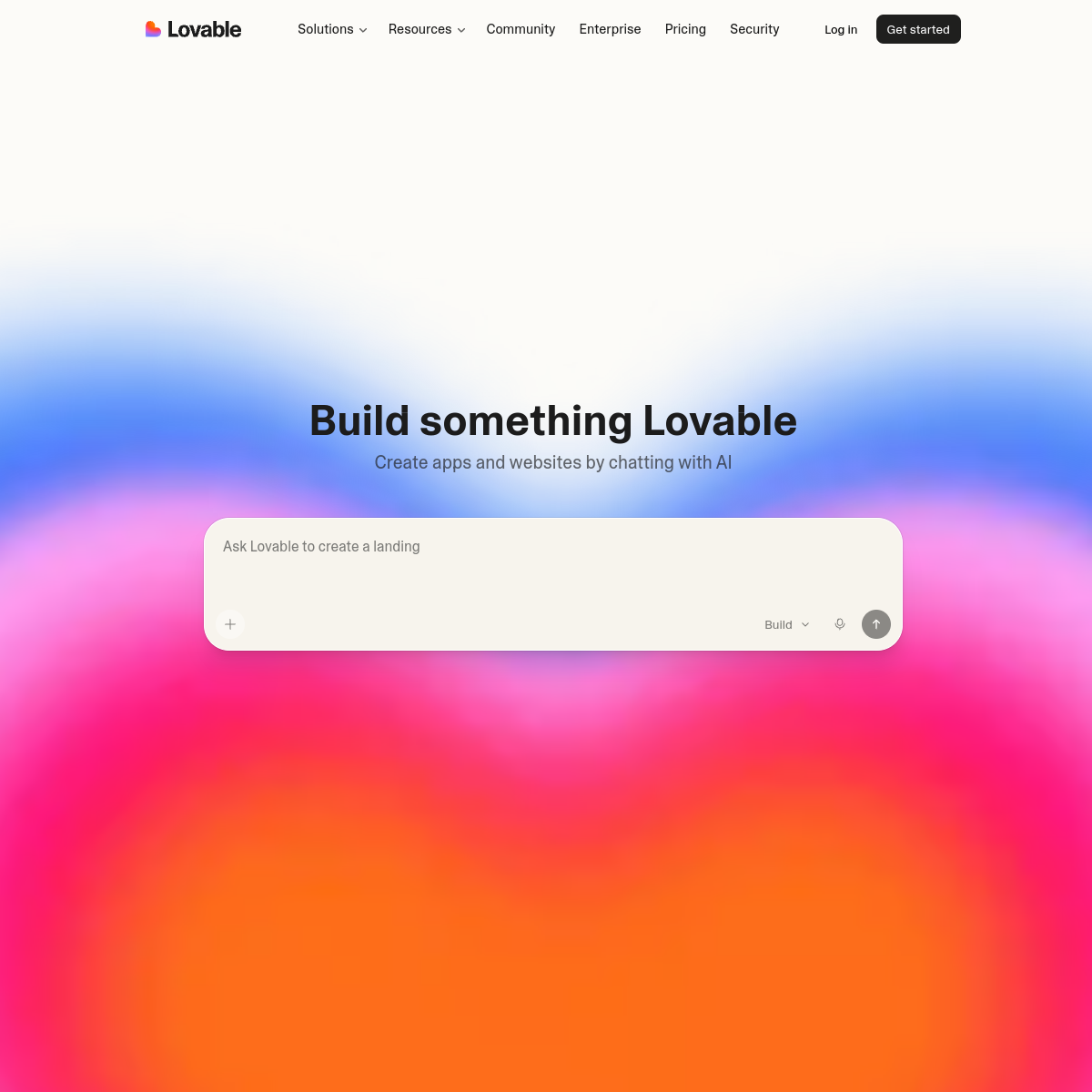
Lovable
Core parameters and statistics
Lovable's core positioning is not "AI writes code", but "AI generates runnable applications" - it switches developers from line-by-line coding in the IDE to conversational demand description. The speed difference in productization is its most prominent competitive lever.
| Projects | Public Information |
|---|---|
| Product positioning | AI full-stack application generation platform |
| Core Competencies | Natural Language → Front-end and Back-End Code + Database + Deployment |
| Technology stack base | React, Tailwind CSS, shadcn/ui, Supabase |
| Deployment path | Lovable Cloud hosting, custom domain name, code export |
| Support Platform | Web (Desktop + Mobile Adaptation) |
| Place of Belonging | Sweden (SE) |
| Security Certification | SOC 2 Type II, GDPR, ISO 27001 |
| Latest version | Builder 2026 (2026-03) |
| Founder | Anton Osika |
Uniqueness of positioning: Lovable does not try to replace professional IDEs (such as VS Code) or AI code completion tools (such as Cursor), but directly targets "non-engineers" and "light engineering teams", compressing the link from an idea to an accessible URL into one conversation. This means that its target audience is not programmers who spend 8 hours coding, but product managers or founders who need 30 minutes to launch a prototype.
Delivery form: Lovable adopts a "platform as a service" model - users do not need to manage servers, domain names or CI/CD processes. The generated applications run directly on Lovable Cloud, and the platform handles infrastructure, databases, storage and AI gateways. This fully managed model lowers the engineering threshold for going online, but also sets boundaries for application scale and degree of customization: when an application requires a specific cloud service provider's private API or highly customized back-end logic, migrating from Lovable Cloud to independent deployment will face reconstruction costs.
User and market recognition
Lovable's market growth mainly comes from "non-technical founders and product teams", a user group ignored by traditional development tools. Its word-of-mouth spread path is different from the way Cursor or GitHub Copilot spread in the developer community.
Target customer group portrait: The official website directly lists 7 roles such as Founders, Product Managers, Designers, Marketers, Sales, Ops, and People. There are almost no "software engineers" in the traditional sense. This shows that Lovable's product strategy is to intentionally bypass the competition for the stock of developer tools to serve the "long-tail application needs" that are suppressed by high development costs - internal company management tools, event registration pages, customer demonstration prototypes, marketing landing pages, etc.
Community and Ecology: Officially claims that "millions of projects" are built on Lovable. In the Discord and Reddit communities, Lovable's discussions focus on the success stories of "going online from scratch in X hours" rather than API or architecture discussions in traditional development communities. This community form that focuses on "finished product display" rather than "coding process" further strengthens its positioning for non-engineers. At the same time, Lovable's MCP server has received official integration support from mainstream AI clients such as Claude and ChatGPT, verifying the maturity of its technology and product standards.
Cost advantage
Lovable's cost advantage is not reflected in API unit price or computing power efficiency (it does not sell models), but in the efficiency dimension of "compressing the total cost of ownership of application development from weeks to hours."
C-side/Individual users: Start with zero threshold: The Free plan provides 5 construction quotas per day (maximum 30 times per month), including 20 Cloud quotas/month and 4 AI quotas/month. For individual users who occasionally build prototypes or for learning purposes, the free plan is sufficient. But please note: once the free plan quota is exhausted, construction will stop directly until the quota is refreshed next month. The Free plan includes 5 lovable.app subdomains, and custom domain names are not available.
Pro plan ($25/month): Provides 100 monthly build quotas, supports quota accumulation, custom domain names, member rights management, removal of Lovable brand logo, and email support. For solo founders or teams of 2-3 people, the Pro plan covers the typical path from prototype to light production launch. Overage can be purchased in booster packs for $0.30/credit.
Business Plan ($50/month): Adds team workspaces, role-based access control, internal publishing capabilities SSO, priority support, and Security Center to Pro. 100 credits/month per member. Suitable for growing teams that require permission isolation and process control. Over-purchase prices are $0.60/credit, about twice as much as Pro.
Enterprise Plan: Based on platform fee + pay-as-you-go pricing, including custom connectors, design system synchronization SCIM, audit logs, release control, dedicated support, etc. Prices require business confirmation and are suitable for large organizations or compliance-sensitive industries.
The truth about free: The usage restrictions of the free plan are clearer than most competing products - 5 cloud and AI builds per day, limited quota, and no custom domain names. If you underestimate the number of iterations, you can easily reach the upper limit during intensive development periods. It is recommended to choose at least the Pro plan in formal projects to avoid interrupting the workflow due to exhaustion of quota.
Main functions
Lovable's functional system revolves around the main link of "from dialogue to accessible applications". It does not pursue the stacking of the number of functions, but emphasizes the relevant experience of each section.
-
Conversational application generation (Build Mode): This is the core capability. Users describe their needs in natural language, and Lovable generates full-stack code including front-end pages, back-end logic, and data models. Unlike traditional code completion tools, the output of Lovable is a directly runnable application rather than a code snippet. Implementation Tips: It is recommended to split complex multi-step requirements into multiple iteration rounds. When a single Prompt carries too many semantics, the generation quality will decrease.
-
Plan Mode: A low-cost exploration mode that only costs 1 credit per conversation. Lovable does not actually modify the code, but analyzes requirements, provides implementation estimates and technology selection suggestions. Applicable tasks: Requirements feasibility assessment, technical solution comparison, and architecture design discussion. This feature is especially valuable for non-technical users—to verify the feasibility of an idea before committing to building credits.
-
Lovable Cloud Hosting and Database: Generated applications can be deployed directly to Lovable Cloud, with built-in PostgreSQL database, edge functions, storage and real-time communication capabilities. Cloud usage (database instances, network, storage, compute, real-time communications) is deducted from the unified credit pool. Implementation Tips: Cloud database instance size and billing are directly related to the number of visits to the application. Traffic estimates need to be evaluated before going online to avoid excessive charges.
-
Connectors: Built-in connectors for third-party services such as Gmail, Notion, Linear, Slack, Miro, Supabase, etc., which can be authorized directly in the conversation and integrated into the application. Value: Solve the problem of "AI generates code but cannot connect to real data", so that the prototype has the ability to interact with the real system from the beginning of generation.
-
Lovable MCP Server: Through MCP (Model Context Protocol), any AI client that supports MCP (Claude, Cursor, VS Code, etc.) can directly call Lovable's project creation, code reading, file editing, SQL execution, deployment triggering and other tools. Value: Transform Lovable from an independent platform into a "full-stack execution engine" for other AI Agents, expanding usage scenarios - for example, after completing requirements analysis in Claude, directly call Lovable to generate applications and deploy them.
Lovable’s model and version evolution
The version evolution of Lovable (formerly known as GPT Engineer) reflects the transformation route from "technical experiment" to "productized platform".
GPT Engineer Lab Phase (2024-02)
The project was originally named GPT Engineer and was an experimental AI code generation tool. The core was to verify the automated path "from natural language to executable code". This stage is oriented to the developer community, and the output is mainly code warehouse.
Lovable Brand Release (2024-09)
The product was renamed Lovable and transformed from a command line tool to a visual web platform. Online preview, project management, and template systems have been added, and the target users have expanded from developers to product managers and founders. This rebrand marks a key transition in product positioning - from "AI development tools" to "AI application generation platform."
Team collaboration and deployment enhancements (2025-11)
Introducing team workspaces, role permissions, third-party service integration (Supabase, Stripe, etc.), custom domain names, and production deployment processes. The product evolved from a single-user prototyping tool to a team platform that can support commercial MVPs.
Builder 2026 (2026-03)
The latest version currently focuses on improving the stability of complex business process generation, strengthening authentication and payment integration, and optimizing the full-link experience from prompts to deployable applications. The unified credit system is launched, integrating Cloud and AI usage into a single credit pool.
Technical advantages
Lovable's technical advantage lies not in the reasoning capabilities of the underlying model (it calls third-party large models), but in the system engineering encapsulation around the "application generation" scenario.
Full-stack scaffolding automation: Lovable automatically configures the React front-end Tailwind CSS style system shadcn/ui component library, routing structure, and Supabase data layer every time a new project is generated. Users do not need to manually configure the build tool CSS framework or database connection. Effect: The time from zero to runnable application is reduced from "days" to "minutes".
Context-aware incremental editing: Lovable maintains the complete project context during iterative editing, including code structure, data model, and existing user interaction processes. Subsequent modifications can understand "what the current application looks like" rather than just "what the current Prompt says". Effectiveness: Reduce regression problems caused by context loss - this is a quality slippage that most conversational generation tools are prone to after many iterations.
Unified credit budget system: Integrate the three consumable services of building and hosting AI gateway into the same credit pool, and users only need to manage one number. Credits are consumed with greater transparency - the exact cost of each message can be viewed after Build Mode ends. Engineering significance: Team managers can budget and control members' cloud resource usage (by setting member credit limits) without going into technical details.
MCP integrated architecture: Lovable MCP server and AI client form a two-way control link - Agent can drive Lovable completely programmatically through tools such as create_project, send_message, read_file, execute_sql, deploy and other tools. This architecture expands Lovable from "an application directly operated by users" to an "infrastructure layer that can be orchestrated by other AI systems."
How to use
The usage paths of Lovable are divided into two main lines: "direct use" and "calling through Agent". The former is for end users, and the latter is for AI Agent developers.
| How to use | Suitable for the crowd | Entrance | Features |
|---|---|---|---|
| Web Editor | All users | lovable.dev → Create project | Conversational full-stack generation, visual editing |
| Getting started with templates | Rapid prototyping needs | lovable.dev/templates | Start customizing from pre-built templates |
| Lovable MCP | Claude, Cursor, VS Code users | MCP client connection | Agent programmatic driver Lovable |
| API / Connectors | Technical integration requirements | Document center configuration | Connecting with third-party services |
Typical Build Process (Web Editor):
- Create a new project in lovable.dev and select or skip templates.
- Use natural language to describe the application goal (for example: "Create a SaaS landing page, including Hero, pricing table and registration form, and store the data in Supabase").
- Confirm the scope of requirements and implementation plan in Plan Mode (optional, consumes 1 credit point).
- Switch to Build Mode, Lovable generates full-stack code and displays the preview in real time.
- In subsequent iterations, ask to modify styles, fields, permissions or integrate third-party services through dialogue.
- After completing development, obtain a publicly accessible URL through one-click deployment.
MCP calling typical process (Agent scenario):
- Complete requirements analysis and solution design in Claude/Cursor.
- Call
create_projectto create a Lovable project through the MCP tool. - Send build instructions to Lovable through
send_message. - Review the generated code through
read_fileand propose modifications. - Directly operate the database schema through
execute_sql. - Trigger production deployment through
deployand get the URL.
Product Pricing
Lovable adopts a two-dimensional pricing model of "tiered subscription + credit point billing". For details, please refer to the previous chapter on cost advantages. Here is the cost deduction and usage suggestions based on credit points.
Detailed explanation of the credit system: Lovable unifies the three usages of build (Build), hosting (Cloud) and AI gateway into "credit points". In build mode, the cost of each edit fluctuates according to complexity - about 0.5 credits for a simple style adjustment, about 1.2 credits for adding a complete authentication process, and about 2.0 credits for generating a landing page containing images. The Pro plan provides approximately 50-200 edits per month for 100 credits, depending on task complexity.
Cost deduction reference:
- Lightweight Prototyping (average 30-50 edits per month): Basic coverage with the Free plan (5 free builds per day).
- MVP Development and Iteration (average 100-300 edits per month): Pro plan $25/month + may require additional purchases of 1-2 credit packs ($15-30).
- Team collaboration production (average 500+ edits per month): Business plan $50/month/person, including 100 credits/person, excess $0.60/credit.
- High Frequency Production and Compliance Needs: Enterprise plan is quoted on a commercial basis.
Fee Renewal and Expiration: Monthly plan credits are valid for 2 months, and supplemental credits are valid for 12 months. Unused quota is automatically accumulated (subscription required to remain valid). This means that if the usage in a certain month is low, it can be accumulated and used in the next intensive development period.
Application scenarios
Lovable's application scenarios focus on "application types that need to be launched quickly but do not require extreme performance or deep customization." Its core value is to reduce engineering friction from idea to launch.
-
Startup project MVP and prototype verification: Founders use Lovable to complete a runnable prototype of the product concept in 1-2 days for customer demonstrations, investment pitches or early user testing. Compared to traditional outsourcing (2-4 weeks, thousands of dollars), Lovable compresses time into hours. Implementation Tips: The MVP stage should give priority to the integrity of the core process rather than the pixel-level perfection of the UI. Lovable's rapid iteration capabilities are of greatest value in this scenario.
-
Internal enterprise tools and operation backend: Non-technical teams (operational HR, marketing) build internal tools such as management backend, approval system, and data entry interface by themselves. Traditionally these requirements have required queuing development resources. Implementation Tip: Internal tools involving sensitive data need to evaluate Lovable Cloud's data sovereignty and compliance terms, and if necessary, contact the Enterprise plan to obtain private deployment options.
-
Marketing landing page and event site: The marketing team creates product landing page and event registration system Landing Page A/B test version. The pages generated by Lovable are naturally adapted to mobile devices, and come with CDN and domain name management through Lovable Cloud. Implementation Tips: Marketing scenarios have high requirements for SEO and page loading performance. It is recommended to check the Lighthouse score after generation and configure SSL on the custom domain name.
-
SaaS Product Add-ons: Embed accessibility features built with Lovable into existing products - such as user consoles, data dashboards, configuration wizards. Connect with the data layer of existing business systems through Connector capabilities. Implementation Tips: This scenario requires evaluating the network latency and data synchronization complexity between Lovable Cloud and the enterprise's existing infrastructure. The hybrid architecture may introduce additional operation and maintenance burdens.
-
Education and Teaching Demonstration: In programming teaching and product design courses, teachers use Lovable to quickly generate sample applications to demonstrate specific concepts or architectural patterns. Students can also complete coursework on full-stack applications without an engineering background.
Applicable people
Lovable's product design deliberately reduces the prerequisite "engineering knowledge", which makes its core user group highly non-overlapping with traditional development tools.
-
Independent founders and non-technical entrepreneurs: Founders who do not have an engineering team but have software needs use Lovable to complete MVP development by themselves, avoiding early equity dilution and outsourcing communication costs. Unfit Boundary: When product logic involves complex algorithms, high-performance computing, or specific hardware integration, the quality of Lovable's scaffolding is not sufficient to support production-level requirements, and a professional engineering team is still required to intervene.
-
Product managers and designers: Before delivering requirements to engineers, use Lovable to generate interactive prototypes to verify the understanding of requirements and the rationality of the user process. This can significantly reduce rework caused by ambiguity in requirements documents. Not suitable for boundaries: Lovable's design output is limited to the shadcn/ui component library style and is not suitable for brand-level products that require highly original visual design.
-
Operation and Marketing Team: Self-service creation of event landing pages, user research tools, and content management backend. Not applicable to the boundary: For operations that have strict compliance requirements for data security (such as processing user payment information, health data), you need to confirm whether Lovable Cloud's certification coverage (SOC 2/GDPR) covers its own business scenarios.
-
Small development team: Used as an "accelerator" - handing over basic CRUD page and template work to Lovable, the team concentrates on core business logic and architecture design. Implementation Tips: It is recommended to export the warehouse after Lovable generates the code, and complete subsequent in-depth customization in the local IDE instead of relying entirely on the online editor.
-
Educators and Students: Use Lovable as an "application demonstration generator" in programming teaching scenarios. Not suitable for boundaries: Lovable is not suitable as an introductory programming teaching tool because it does not show the coding process and directly outputs the finished product, so students cannot learn basic programming skills from it.
Summary and Outlook
Lovable redefines the boundaries of "AI development tools" - it is not a tool to help programmers write code, but a platform that allows non-programmers to build runnable applications.
Current core advantages: In the link "from idea to accessible URL", Lovable is one of the most complete products currently. Full-link closure (generation → preview → iteration → deployment) lowers the technical threshold, the unified credit system simplifies cost understanding, and the MCP server opens up new scenarios for agent orchestration. SOC 2, GDPR, and ISO 27001 certifications provide it with basic compliance qualifications in corporate procurement.
Main current limitations: The code generated by Lovable is not as good as the output of professional engineering teams in complex business logic, large-scale data operations, and extreme performance scenarios; the debugging capabilities of the online editor are limited, and the diagnostic path is limited when encountering deep bugs; the application architecture is limited by the runtime context of Lovable Cloud, and migrating to independent deployment requires additional work; the marginal cost of the credit system is higher for heavy users.
Follow-up observation points: Whether Lovable plans to open up deeper back-end logic customization capabilities (such as custom cloud functions, message queues) to break through the current application complexity ceiling; whether the MCP ecosystem can attract enough third-party Agent developers to form a network effect; the private deployment progress of the Enterprise solution is crucial to the attraction of compliance-sensitive industries; the depth of integration with mainstream cloud service providers (AWS, GCP, Azure) will directly affect the adoption speed of large enterprises.
Procurement and Adoption Risk Assessment: For individuals and startup teams, Lovable’s Free/Pro plan provides a very low-risk trial and error path—with a monthly investment of $25, you can get full MVP building capabilities. It is recommended to start with the prototype verification scenario, confirm product-market fit, and then evaluate whether it is necessary to migrate to a traditional development stack. For medium and large enterprises, it is recommended to first pilot the "shadow IT" method (non-core process) within the IT department or marketing department to verify the difficulty of getting started with the platform and the quality of the output, and then decide whether to incorporate it into the company's formal tool matrix and upgrade to the Enterprise solution. Enterprises need to focus on the following before purchasing: data sovereignty clauses (the data storage location of Lovable Cloud), code ownership (officially clear that users own the project code), service level agreements (SLA), and security audit requirements for MCP integration.
Related tools:  GitHub Copilot,
  Cursor
Version Info
- Lovable Builder 2026 :Improve the stability from Prompt to deployable applications, strengthen database, authentication and payment integration capabilities, and support the generation of more complex business processes.
- Team collaboration and deployment enhancements :Supports team collaboration, third-party service integration and online process optimization, suitable for commercial MVP.
- Lovable brand launch :The product is launched online to provide a more complete project management and visual construction experience.
- GPT Engineer Lab stage :With experimental AI application generation capabilities as the core, verify the automated path from requirements to code.
User Reviews