 Lunary
Free
Lunary
Free
Lunary is an AI development tool and LLMOps platform for LLM application teams. It focuses on observability, logs, link tracking Prompt template Prompt Playground, data sets, evaluation, feedback and security compliance to help teams advance AI applications from "callable models" to "monitorable, iterable, and manageable".
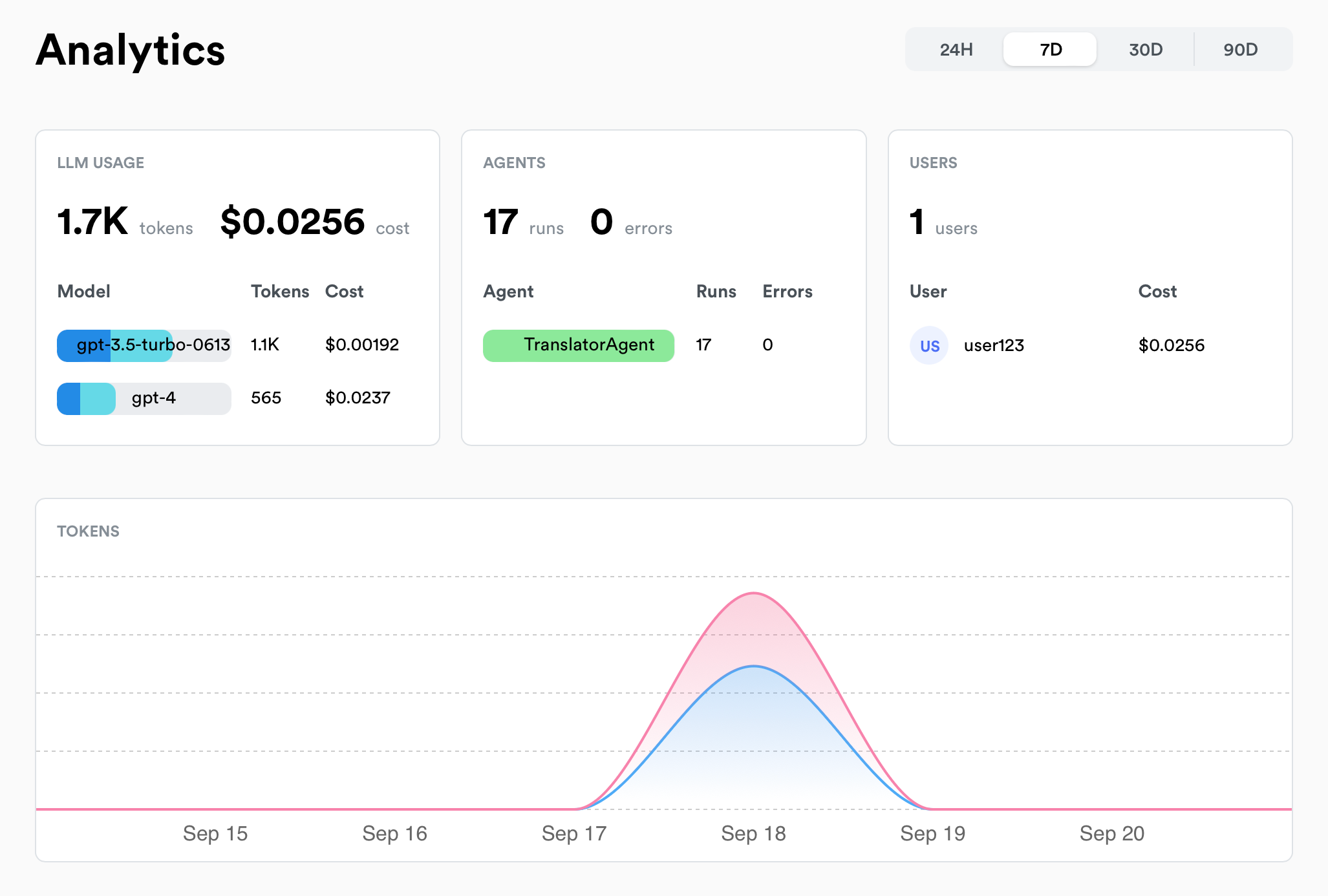
Lunary tool text
Core parameters and statistics
| Parameters | Current public information | Verification instructions |
|---|---|---|
| Product positioning | Observability and prompt management platform for LLM-based apps | Direct confirmation of official website title and description |
| Core capabilities | Analytics, Logs, Tracing, Prompt Templates, Prompt Playground, Evals, Datasets, Feedback | Official docs function page and API index confirmation |
| Access method | Python SDK, JavaScript SDK, OpenTelemetry, OpenAI, Anthropic, Azure OpenAI, LangChain, LiteLLM, Ollama, etc. | Official docs integration directory confirmation |
| Deployment methods | Lunary Cloud + Enterprise Edition self-hosted | Official security documentation and Docker / Kubernetes documentation confirmed |
| Security Compliance | SOC 2 Type 2, ISO 27001:2022, GDPR / CCPA Guidelines | Official Data Security Documentation Confirmation |
| Official website customer logo | IBM, Zurich, Netomi, Close, DHL and other brand logos | Official website homepage is publicly displayed, the specific contract size is not disclosed |
| Product boundaries | Monitoring, debugging, evaluation and governance LLM applications, not model training platforms | Summarized by official functional structure and document scope |
The core value of Lunary is not to "include another layer of model API", but to put on the same workbench several types of issues that are most difficult to continuously manage after the LLM application is launched: who is calling, how much money is spent, where are the delays and errors, which version of the prompt takes effect, whether the experimental output can be reproduced, and how user feedback is fed back to evaluation and iteration.
In terms of verification, this article is based on the lunary.ai official website, docs.lunary.ai official documents, official llms.txt document index and public security/self-hosted documents; no inferences are made about the undisclosed number of customers, revenue, retention, founders and financing data.
User and market recognition
Lunary is not intended for purely personal toy AI tools, but for teams that have already embedded LLM calls into product, customer service, internal applications, or agent workflows. The official website expresses it as an observable and prompt management platform for LLM-based apps, and displays the enterprise customer logo and SOC 2, ISO 27001 certification logo on the homepage, indicating that its business narrative focuses on production availability, team collaboration and security trust.
From the developer's side, Lunary's recognition is mainly reflected in its complete access path: it supports both SDK packaging of common model suppliers and the OpenTelemetry standard entrance. For teams already using LangChain, LiteLLM, Ollama, or a custom model gateway, this makes it easier to drop into existing architectures than a “one model vendor only” monitoring tool.
It should be noted that the official website does not disclose the verifiable total number of customers, monthly call volume ARR or industry penetration rate. Therefore, accessible product capabilities, security documentation, self-hosting requirements and pilot data should be used as the main basis for procurement evaluation, rather than directly equating customer logos with scale success.
Cost advantage
Lunary's cost advantage mainly comes from "reducing invisible losses" rather than simply reducing the unit price of model tokens. After LLM applications enter production, the really expensive parts are often unlocated anomalies, confusing Prompt versions of repeated experiments, no user feedback, and the lack of comparable data when switching models.
| Cost Hierarchy | Lunary's Exposed Capabilities | Value Judgments |
|---|---|---|
| Personal/early projects | The official website Pricing page provides a free starting point | Suitable for low-cost verification log Prompt management and basic monitoring process |
| Development Team | Web Console + SDK + API + OpenTelemetry | Move quality, cost, delay and error location forward into the development and launch process |
| Enterprise Deployment | Scale/Enterprise, Audit Reporting, Self-Hosted Docker/Kubernetes Documentation | For organizations with data boundaries, compliance auditing, and private deployment requirements |
| Hidden costs | Model calling fees, evaluation sample maintenance, data retention strategy, permission management | Lunary reduces troubleshooting and governance costs, but does not eliminate model and engineering costs |
For the team, Lunary's ROI should be measured by "reducing the troubleshooting time of an online incident", "reducing the risk of Prompt regression", "reducing invalid model calls" and "allowing non-engineering members to safely participate in Prompt iterations". If the project is still in the demo stage, the call volume is very low, and there is no need for collaboration, the benefits of the complete LLMOps platform will be underestimated.
Main functions
- Analytics: Automatically counts LLM call costs, call volume token usage, average latency, number of errors, and user usage trends, helping the team shift from "feeling expensive" to attribution by model, user, and time dimensions.
- Logs: Record and check LLM requests and responses, suitable for reviewing exception responses, troubleshooting empty output, locating model supplier errors and analyzing real user input distribution.
- Tracing: Provides link tracking for complex Agent, Chain, and Tool calls. The official SDK supports packaging of agents, chains, and tools, so that multi-step operations in a user request can be viewed in series.
- Prompt Templates: Separate Prompt from the code for storage, version management, collaboration and A/B testing, reducing the friction of having to redeploy the code when changing Prompt.
- Prompt Playground: Provides an interactive Prompt testing environment, which can compare different models, parameters and variables, and can also connect to custom API endpoints to test RAG or Agent systems.
- Datasets and Evals: The official API index includes interfaces such as dataset v2, evaluation, criterion, and result, which are suitable for converting test samples and evaluation processes into repeatable assets.
- Feedback Tracking: supports recording users’ likes, dislikes, comments or customized JSON feedback on answers, and can be used for filtering calls and subsequent fine-tuning data preparation.
- OpenTelemetry access: Receive OTEL traces through
/v1/otel, which facilitates access to multi-language, multi-framework and existing observable systems. - Security & Governance: Provides data security instructions GDPR/CCPA guidelines, self-hosted boundaries, secure contact email, and SOC 2 / ISO 27001 instructions.
Combined, these capabilities make Lunary more like an “AI application production console” than a standalone log viewer. It puts prompts, calls, user feedback and review data in the same context, reducing the cost of splicing evidence across tools.
Model and version evolution
Lunary's version evolution cannot be understood solely by traditional client version numbers. The public page presents a set of continuous expansion of cloud platform capabilities: from basic logs and observables to Prompt template playground, data sets, evaluation, feedback OpenTelemetry and self-hosting.
Currently verifiable public nodes include:
- Current public version of official website: The official website directly defines Lunary as the observable and prompt management platform for LLM applications, and displays security certification, customer identification and main entrance.
- Official Document Function System: The docs index already includes Observability, Prompt Templates, Prompt Playground, Feedback, Product Analytics, API, OpenTelemetry, self-hosting, security compliance and other pages.
- Enterprise self-hosting example: Docker documentation shows the
lunary/backend:1.4.8andlunary/frontend:1.4.8image combination, indicating that the Enterprise version self-hosting has an independent deployment path.
Therefore, when evaluating Lunary, you should focus more on "whether the capabilities cover your production process" rather than looking for a separate "latest model version". It does not train or release basic large models itself, but serves as a governance layer around the running, debugging, and evaluation of multi-model applications.
Technical advantages
SDK automatic collection: The official Observability document clearly states that analytics and logs will be automatically captured after integrating the SDK. This reduces early access costs, and the team can first obtain costs, delays, errors, and call volume, and then gradually add more detailed tracing and feedback.
Link Level Tracing: For Agent and tool calls, a single LLM request log is often not enough. Lunary's agent, chain, and tool packaging capabilities can group sub-steps into the same link, which is suitable for troubleshooting multi-step problems such as "the tool is called incorrectly", "the search results are incorrect", and "the model answer is affected by the previous step".
Decoupling Prompt from code: Prompt Templates allow developers to render templates through the SDK while still retaining call tracking. This way non-engineering members can participate in Prompt version iterations, while the engineering team retains deployment, permissions, and rollback boundaries.
OpenTelemetry Compatible: OTEL is the universal observability standard. Lunary supports receiving OTEL traces, which means teams can integrate LLM applications into larger distributed tracing systems instead of relying entirely on proprietary SDKs.
Compliance and self-hosting path: The official security document describes the boundaries of responsibility between Cloud and self-hosting, and explains that self-hosting is suitable for scenarios where complete control of data is required. For medical, financial, government or highly sensitive data projects, this is more critical than pure UI functionality.
How to use
| Entrance | Suitable objects | How to use |
|---|---|---|
| Lunary Cloud Web | Product, Engineering, Operation Team | Create a project after registration, view log prompts, evaluation and analysis on the console |
| Python SDK | Python backend, data application Agent project | Install SDK, package OpenAI / Anthropic / Azure OpenAI or manually record run |
| JavaScript SDK | Node.js, Next.js, front-end feedback collection | Connect to JS SDK, monitor model calls and report user feedback |
| OpenTelemetry | Engineering teams with existing observability systems | Send OTEL traces to https://api.lunary.ai/v1/otel |
| API | Platform engineering and internal tools | Automation through APIs such as Runs, Templates, Datasets, Evals, Views, etc. |
| Self-hosted | Enterprise & Strong Compliance Team | Docker / Kubernetes Documentation Deployment using Enterprise Edition |
The recommended implementation path is: first connect to the minimum SDK to collect call logs and costs, then migrate key prompts to Templates; then establish a small evaluation data set to perform regression on core scenarios; and finally incorporate feedback, permissions, self-hosting or OTEL access into production management. This can avoid pursuing "big and comprehensive" from the beginning, but retain the route of expansion to the production system.
Product Pricing
Lunary's official website provides a public pricing page, providing free starting points, paid team slots and enterprise plans for teams of different sizes. Since SaaS prices, event quotas, seats, and functional boundaries will be dynamically adjusted, formal procurement should be based on the real-time Pricing page and contract on the official website.
| Position | Public status | Applicability judgment |
|---|---|---|
| Free / Free starting point | Publicly available on the official website | Suitable for verifying SDK access, basic logs and Prompt workflow |
| Paid packages such as Pro / Team / Scale | Official website Pricing page for public display | Suitable for growing product teams, focusing on verifying event quota, number of members, data retention and collaboration functions |
| Enterprise | The official website provides access to sales communication and enterprise capabilities | Suitable for SSO, auditing, self-hosting, compliance reporting, dedicated support and higher security requirements |
| Self-hosted | Official documentation states that it is only available in Enterprise Edition | Suitable for teams that must keep data on their own infrastructure |
Don’t just look at the monthly fee when evaluating costs. What's more important is to confirm three things: whether your monthly LLM event volume will exceed your quota; how long log and measurement data need to be retained; whether enterprise compliance requires self-hosting, audit reports, or dedicated support. For high-frequency AI products, these boundaries will impact the total cost more than the base subscription price.
Application scenarios
- AI Customer Service and Chatbot Monitoring: Record user messages, model answers, errors and feedback to help the team locate hallucinations, refusals, long delays and high-cost issues.
- RAG System Debugging: Test the retrieval enhancement process in Prompt Playground or custom endpoint, and observe whether the context enters the model correctly through logs/traces.
- Agent Workflow Troubleshooting: Use agent, chain, and tool tracing to observe multi-step reasoning, tool invocation, and subtask execution results. It is suitable for automated assistants, internal operation Agents, and complex workflows.
- Prompt version management: Extract Prompt into a template to support collaboration, version recording, testing and A/B experiments, and reduce online Prompt drift.
- Model and parameter evaluation: Use datasets, criteria and evaluations to make repeatable comparisons of combinations of model prompts, temperatures, maximum tokens, etc.
- Cost and experience monitoring: Observe call volume, cost, latency and errors by model, user and project to provide basis for model routing, caching or current limiting.
- Compliance-sensitive scenarios: When you need to control the data boundary, keep the data in your own territory through the Enterprise self-hosting route.
Applicable people
AI application developers: Already calling frameworks such as OpenAI, Anthropic, Azure OpenAI, Gemini, Mistral, Ollama or LangChain in their code and need to better observe requests, responses, errors and costs.
Product and Operations Team: Need to participate in Prompt iterations, view user feedback, and understand function usage, but do not want to rely on engineering redeployment for every change.
Platform Engineering and LLMOps Teams: Need to establish unified logging, metrics, metrics, and permissions governance for multiple AI projects, especially for teams looking to incorporate OpenTelemetry or self-hosting into their architecture.
Enterprise Security and Compliance Team: Pay attention to SOC 2, ISO 27001, GDPR, CCPA, data processing boundaries and self-hosting requirements. Vendor responsibilities and deployment methods need to be confirmed before going live.
Scenarios that are not very suitable are: only occasionally using chatbots, no real user calls, no Prompt version collaboration, and no need for reviews or log attribution. At this point it is sufficient to complete early validation using the Common Log or the Model Provider Console.
Summary and Outlook
Lunary is suitable for teams taking LLM applications into production. It integrates observability, logs, link tracking prompt management, evaluation, feedback, and security compliance into a set of workflows to solve the problem of "how to continue to improve and control the AI function after it goes online."
Its advantage lies in its wide access surface, complete functions, and official documentation covering Cloud, self-hosted OpenTelemetry and multi-model integration. The current boundaries that need attention are: some business indicators are not public, Product Analytics documents are still being completed, self-hosting is an enterprise version capability, and pilot verification must be done with real call volume, data retention period, and security requirements before purchasing.
If your team already has stable LLM calls and clear quality indicators, Lunary can be used as the LLMOps console to establish and monitor Prompt versions, evaluation and feedback functions; if it is still in the demo stage, it is recommended to first use a free or low-threshold plan to connect to a core link to confirm whether it can reduce troubleshooting time and Prompt iteration risks, and then expand to more projects.
Related tools:  GitHub Copilot,
  Cursor
Version Info
- Lunary Enterprise Edition Docker self-hosting :The official self-hosted Docker documentation example uses lunary/backend:1.4.8 and lunary/frontend:1.4.8, indicating that the enterprise version supports the combined deployment of backend, frontend and PostgreSQL.
- Lunary Cloud current public version :The current public status of the official website and official documents shall prevail, covering Observability, Prompt Templates, Prompt Playground, Evals, Datasets, Feedback, OpenTelemetry, API and self-hosted documents.
User Reviews