 Open Lovable
Free
Open Lovable
Free
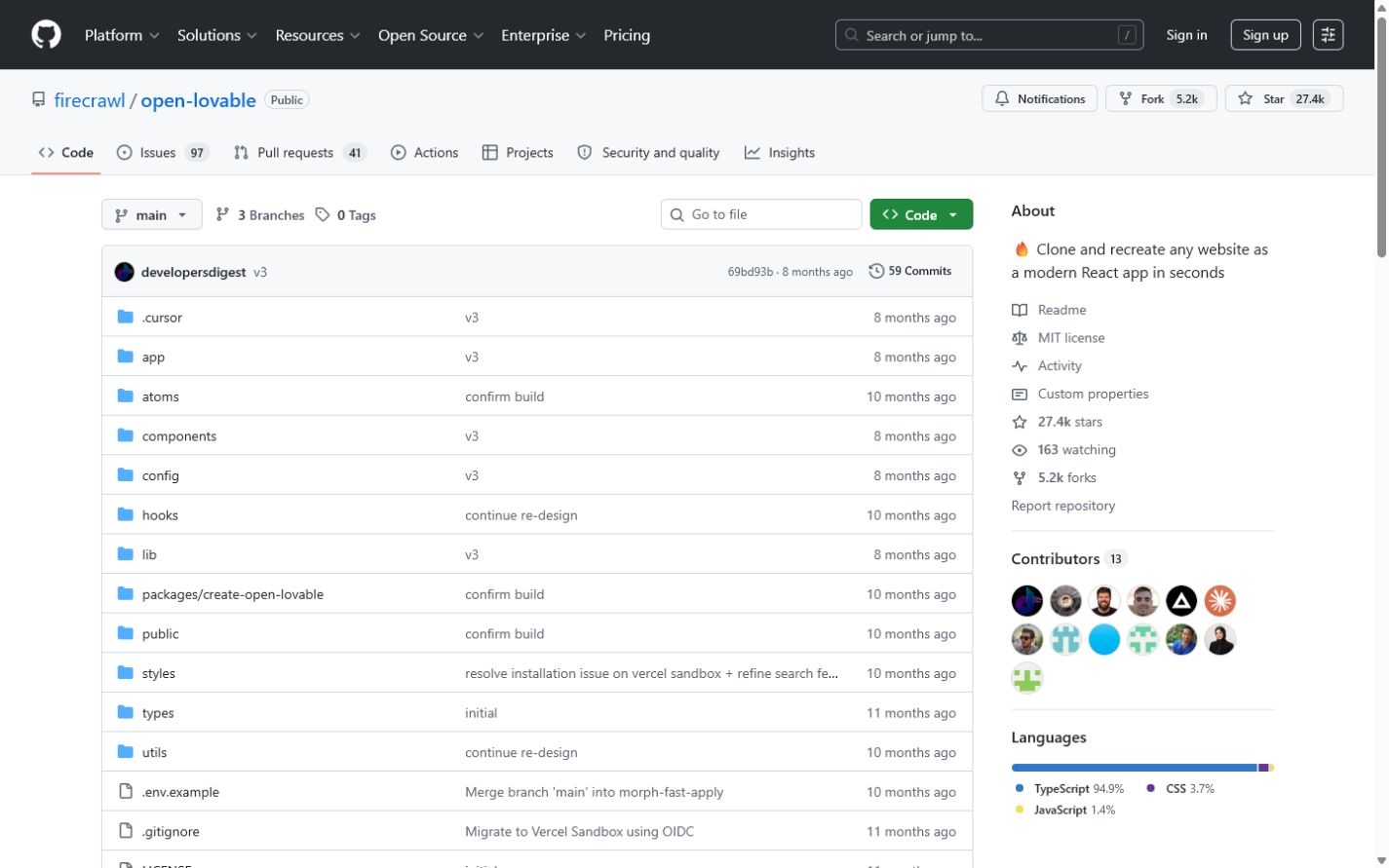
Open Lovable is an open source AI application generation project of the Firecrawl team. It focuses on directly generating React applications through chat, cloning the website structure, and completing editing, previewing, and iteration in the sandbox. It is positioned as an open source alternative implementation of Lovable-style experience.
OpenLovable
Core parameters and statistics
The main delivery form of Open Lovable is closer to [Agent / MCP / Automation Tool]. On the surface, it is a "chat-generated React application", but the bottom layer actually combines web page understanding, code generation, sandbox execution, quick patching and preview feedback into one package.
| Projects | Public Information |
|---|---|
| Project Positioning | Chat with AI to build React apps instantly |
| Code repository | firecrawl/open-lovable |
| Open Source License | MIT |
| Technology stack | TypeScript mainly, Next.js / React route |
| Community size | 27k+ stars, 5.2k+ forks |
| How to run | Local development Vercel Sandbox or E2B Sandbox |
| Dependent Services | Firecrawl, LLM Provider, Optional Morph, Sandbox |
A brief comment: It is not a simple code generator, but a prototype of an open source front-end agent that "can read web pages, write React, and run in a sandbox."
Publicity Verification: The warehouse says "rebuilding the website into a modern React application in seconds". This statement is true for demo and structural reconstruction; but as long as you enter complex interactions, login states, payment flows, or heavy back-end dependency scenarios, you must treat it as a scaffolding, not a complete stand-in.
User and market recognition
The recognition of an open source project depends on two things: one is the size of the community, and the other is whether it hits high-frequency pain points. Open Lovable does both. 27k+ stars shows that it is not a niche experiment, and "using chat to directly generate product prototypes" and "clone site structure for reconstruction" are indeed one of the hottest needs at the moment.
Expert View: The reason why it is popular is not because the code is stronger than all IDE Agents, but because it directly puts the results that product managers, designers, and independent developers want most: "Give me a running front end, don't talk to me about the framework configuration first."
Hidden benefits: For the internal innovation team, the meaning of Open Lovable is to shorten the time for "ideas to be turned into demonstrable interfaces", rather than shortening the time for the final project to go online.
Current Limitations: This type of tool looks like "automatic app creation" to the outside world, but internally it still relies on a large number of third-party keys and sandbox configurations. Enterprises need to have strong DevEx capabilities before adopting them.
Cost advantage
Free truth: The warehouse MIT is open source, and the code can be taken away directly; but to actually run it, you must prepare at least the Firecrawl API Key, an LLM provider Key, and a sandbox environment such as Vercel or E2B. Open source does not mean zero cost.
C-side/Individual: If you only generate landing pages occasionally, the cost is mainly the API call fee; if there are high-frequency cloning and multiple rounds of iterations, the model cost will increase quickly.
Developers/API: The most developer-friendly thing is not "saving money", but replaceability. Switch between providers such as Anthropic, OpenAI, Groq, Gemini and more.
Enterprise/Private: The real cost of enterprise adoption lies in permission management, sandbox governance, code review and compliance, not the warehouse itself.
Hidden Cost: The generated front-end is very fast, but the key to the total cost is whether it can seamlessly connect team specifications, design systems, testing processes and deployment links.
Main functions
- Chat Generation React Application: Generate pages and components directly through conversations.
- Website Clone and Rebuild: Grab the existing website structure and reorganize it into a modern React front-end.
- Sandbox Execution and Preview: Run in a Vercel or E2B sandbox to reduce local context friction.
- Multi-model access: Supports Gemini, Anthropic, OpenAI, Groq and other providers.
- Quick Modify Enabled: Combine with optional Morph Fast Apply for faster editing.
Tool open list: From the perspective of warehouse design, the core actions it exposes to the model can be summarized as crawl/fetch page, summarize structure, generate files, patch files, run sandbox, preview result, iterate from feedback. This is the minimum configuration of an application generation agent.
Architecture Link: LLM -> Open Lovable Orchestrator -> Firecrawl/Code Generator -> Vercel(E2B) Sandbox -> Preview -> Feedback -> LLM.
Model and version evolution
Open Lovable evolves more like open source project milestones than a commercial SaaS release cadence.
Mainline release
- v3: The current mature stage where the warehouse is publicly visible and is centered around the generation, reconstruction and sandbox processes.
Historical nodes
- v2: Earlier stage capability, showing the evolution of the project from "can generate pages" to "can iteratively apply".
Publicity verification: Version iterations show that it is not a one-time sample warehouse, but continues to move closer to a "Lovable-like development experience".
Technical advantages
Engineering Pitfall Guide 1: Deadly loops and token skyrocketing. Page rebuilds and large code rewrites can easily enter a state of repeated generation, and step budgets, task splitting, and clear acceptance conditions must be used to limit idling.
Engineering Pitfall Guide 2: Context overload. If the cloned website is slightly more complex, the DOM, style, and interaction description will overwhelm the context. The structure must be summarized first and then generated in slices, instead of directly feeding the entire site information into the model.
Engineering pitfall guide 3: Safety and ultra vires. Because it will operate the sandbox and dependency keys, production-level credentials must be isolated. It is best to only give the development environment the minimum permissions to avoid model misoperation of deployment resources.
Get started quickly in 3 minutes:
git clone https://github.com/firecrawl/open-lovable.git
cd open-lovable
pnpm install
pnpmdev
FIRECRAWL_API_KEY=<YOUR_FIRECRAWL_API_KEY>
ANTHROPIC_API_KEY=<YOUR_API_KEY>
SANDBOX_PROVIDER=vercel
VERCEL_OIDC_TOKEN=<YOUR_OIDC_TOKEN>How to use
The most typical path is not to "write a requirement document from scratch", but to first give a page target, and then gradually let it add components, data structures, and interactions.
| Path | Suitable for the crowd | Description |
|---|---|---|
| Local startup | Independent developers | Best for debugging and understanding the generated link |
| Vercel Sandbox | Prototype Team | Smoother preview experience |
| E2B Sandbox | Highly experimental teams | More suitable for sandbox execution |
Usage Suggestions: Generate a static front end first, and then add real data and business logic. This is the most stable and most consistent with its capabilities.
Dissuade scenario: Projects that require strict back-end transactions, consistent permission systems, complex business logic, and enterprise-level auditing are not suitable for directly relying on it to generate production applications in one step.
Product Pricing
Open Lovable itself is open source and free, but running it involves a variety of external costs.
- Individual: Free warehouse, main payment model and crawling service.
- Developers: Cost depends on LLM and sandbox options chosen.
- Enterprise: Plus code auditing, permission isolation, private deployment and internal maintenance costs.
The free truth: What you get for free is the “platform shell”, not the “stable mass production capability”.
Application scenarios
- Quickly generate marketing pages and MVP frontends: Demo-ready versions within hours.
- Competitive product page reconstruction and structure research: used as inspiration and reconstruction sketch.
- Design to Code Transition: Give design, product and front-end a common interactive prototype.
- Independent developer trial product ideas: Greatly reduce the cost of the first version of the interface.
Dimensionality reduction strike scenario: It is most lethal when it needs to be fast, able to be demonstrated, and able to be modified repeatedly, but does not require a complete backend and production-level quality.
Applicable people
- Independent Developer: Best for quickly making an MVP.
- Product Managers and Designers: Can get runnable prototypes at a lower threshold.
- Innovation Team: Suitable for rapid trial and error and internal proof of concept.
Dissuaded/not applicable to people: It is not suitable to use it as the final engineering production line for back-end business teams, companies with strong compliance constraints, and organizations that hope to "build once and go online directly". Current limitations: As an open source alternative, Open Lovable still has a gap in functional integrity and stability compared to the original Lovable. Teams need to evaluate whether they accept the functional boundaries of an open source solution.
Summary and Outlook
The value of Open Lovable is not to completely automate software engineering, but to shorten the time from "front-end application sketch to runnable prototype" sufficiently short. It is very suitable for experimenting with ideas, making interfaces, and rebuilding, but it is not suitable for jumping directly to the production system.
Current limitations: Strong reliance on external keys and sandboxes, complex application contexts are easily overloaded, and the long-term maintainability of the generated code is unstable.
Procurement/Adoption Risk Assessment: If the team wants to adopt, it is recommended to position it as a "front-end prototyping agent" rather than a "full-stack delivery agent". First examine whether it can really reduce prototype time, and then decide whether to build an internal platform package around it. Otherwise, it will easily be backlashed in terms of sandbox, key and code quality.
Related tools:  GitHub Copilot,
  Cursor
Version Info
- Open Lovable v3 :There is no official precise release date for the v3 stage version visible in the warehouse README and submission records. A relatively complete chat generation, website reconstruction and sandbox execution link has been formed.
- Open Lovable v2 :The warehouse history and deployment configuration show the earlier version. There is no official precise date yet, and it can be regarded as the main iteration form before v3.
User Reviews