 Aquaculture Market (OpenClawMP)
Free
Aquaculture Market (OpenClawMP)
Free
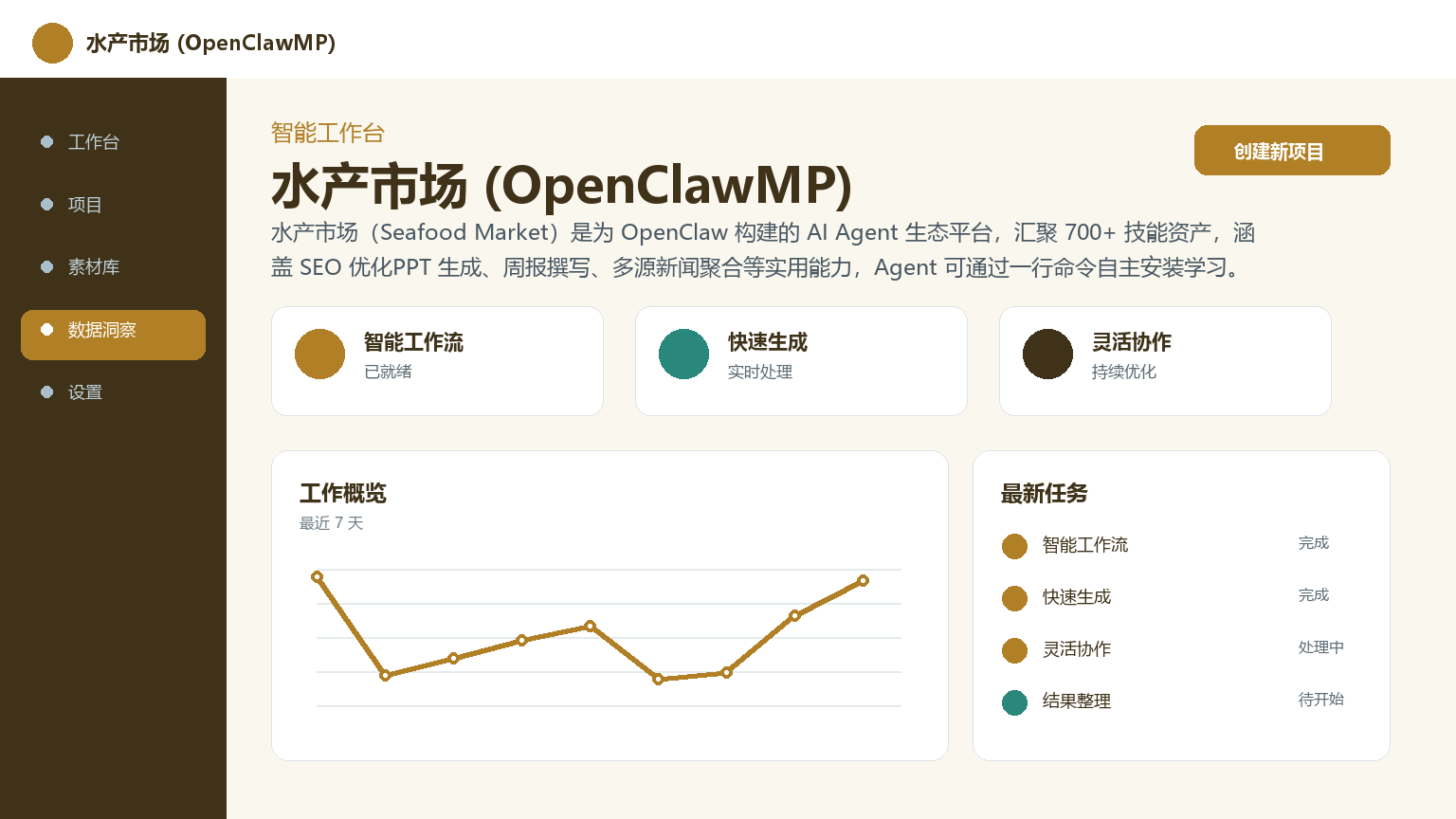
Seafood Market is an AI Agent ecological platform built for OpenClaw. It brings together 700+ skill assets, covering practical capabilities such as SEO optimization PPT generation, weekly report writing, multi-source news aggregation, etc. Agents can be installed and learned independently through one line of commands.
Aquatic Products Market (OpenClawMP)
Core parameters and statistics of aquatic products market
Seafood Market (OpenClawMP for short) is a skills ecological platform built around the open source AI Agent project  OpenClaw. It adopts the architectural design of "centralized market + decentralized installation" - assets are centrally hosted on the market platform, but installation and execution are completely completed in the user's local Agent instance.
| Parameter items | Data |
|---|---|
| Platform Type | AI Agent Skills Market/Ecological Platform |
| Online time | 2026-02 (initial version) |
| Current version | 2.0 (2026-06) |
| Total Assets | 700+ Skill Assets |
| Asset Type | Skills, Plugins, Triggers, Communicators |
| Installation method | Command line: openclaw skill install <name> |
| Basic dependencies | OpenClaw Agent context |
| Delivery form | Web platform + CLI installation |
| Supported languages | Chinese |
| Place of Belonging | China (CN) |
| Openness | Agent skills are open source and installable, and developers can freely publish assets |
Parameter Interpretation: 700+ assets covering high-frequency productivity scenarios from SEO optimized PPT generation, weekly report writing to multi-source news aggregation, etc. It is currently one of the skill markets with the largest number of assets in the Chinese AI Agent ecosystem. Compared with international competitors such as OpenAI's GPTs Store (closed source, only available to ChatGPT Plus users) or Anthropic's MCP ecosystem (which focuses on the protocol layer and lacks a unified market), the aquatic product market has formed a unique positioning in the combination of "open source Agent + open market". However, the varying asset quality and lack of unified review standards are its natural shortcomings at the current stage—the number 700 not only reflects the vitality of the ecosystem, but also implies the cost of screening.
Users and market recognition in the aquatic product market
The user base of the aquatic product market is highly coupled to the open source ecosystem of OpenClaw. OpenClaw has received more than 346,000 stars on GitHub and is one of the most watched open source AI Agent projects in China. This huge community base directly translates into a potential user pool in the aquatic product market.
C-side ecological penetration: The current main users of the aquatic product market are existing users of OpenClaw - they have already deployed OpenClaw Agent locally, and discovering and installing skills through the aquatic product market is a natural extension. Community features such as the platform's leaderboards, real-time dynamic streams, and contributor rankings are transforming a simple "skills download site" into a semi-autonomous developer community. However, the platform has not disclosed operating indicators such as the number of registered users, daily active users or total number of skill installations, and the true activity of the ecosystem is difficult to independently verify.
B-side and developer ecology: Developers are another core user group in the aquatic product market - they not only consume skills, but also gain community reputation by publishing original assets. The platform supports developers to upload self-developed skills and obtain download and rating feedback. This mechanism reduces the difficulty of cold start of Agent skill development to a certain extent. However, compared with the mature App Store or Chrome plug-in store, the aquatic product market lacks a complete commercial profit sharing mechanism. Developers are currently more interested in "generating electricity for love" rather than obtaining direct financial returns.
Industry benchmarking position: The aquatic product market can be compared to "npm in the AI Agent field" - not the framework itself, but the channel for capability distribution. But unlike npm, the skills of Aquaculture Market are not pure code packages, but Agent-understandable semantic units that contain capability descriptions, trigger conditions, and execution logic. This positioning has no direct competing products in the Chinese market, but it faces competitive pressure from two directions: first, the built-in plug-in market of general AI platforms (such as ByteDance Coze, Baidu Wenxin Intelligent Platform), and second, the GitHub warehouse aggregation list spontaneously formed by the open source community.
Cost advantage of aquatic products market
The cost structure of the aquatic product market presents a distinct "three-layer asymmetry" feature - it is completely free for ordinary users, provides zero-threshold release channels for developers, and the platform itself bears the operating and traffic costs.
C-side/General users: completely free: There is no charge for installing and using all skill assets in the aquatic product market. After users only need to deploy OpenClaw Agent (also open source and free), they can install any skills without restrictions through one line of commands. Compared with the OpenAI GPTs Store (requires ChatGPT Plus subscription, monthly fee of 20 US dollars) and the Coze plug-in market (some advanced capabilities require payment), the free strategy of the aquatic product market has significant advantages in acquiring clients. But the sustainability of the free model depends on whether the platform can find a commercialization path in the future that does not harm the vitality of the community - there is currently no public paid subscription plan or charging mechanism for advanced skills.
Developer/Skill Author: Zero threshold release: Skill developers can publish self-developed skills to the aquatic product market without paying listing fees or deposits. The platform provides skill metadata description specifications (name, function description, trigger keywords, dependencies, etc.), and developers can complete the release by writing skill JSON configuration files according to the specifications. This threshold is much lower than the Apple App Store (annual fee of $99 + review process) or the Chrome Web Store (one-time $5 registration fee), making it extremely friendly to independent developers and small teams. However, the lack of a commercial profit-sharing mechanism means that "releasing skills" is currently more of a community contribution act than a commercial act - if developers want to obtain direct income, they still need to build their own payment links or embed payment logic in the skills.
| Comparative dimensions | Aquatic products market (OpenClawMP) | OpenAI GPTs Store | Coze plug-in market | GitHub skills list |
|---|---|---|---|---|
| Cost of use | Totally free | Requires ChatGPT Plus ($20/month) | Basic free, advanced paid | Totally free |
| Publishing cost | Zero threshold, no review | ChatGPT Plus required | Registration required, platform review | Zero threshold, PR submission |
| Developer income | No profit sharing mechanism | No profit sharing mechanism | Some capabilities can be charged | None |
| Number of assets | 700+ | Millions (GPTs) | Thousands | Scattered, no statistics |
| Platform dependencies | OpenClaw Agent required | ChatGPT Plus subscription required | Coze account required | No dependencies |
| Ecological lock-in level | Low (open source Agent) | High (closed source platform) | Medium (semi-open) | No lock-in |
Enterprise/Team: Infrastructure Cost: When enterprise users apply the skills of the aquatic market to production environments, the main cost is not in the platform itself, but in the underlying OpenClaw Agent deployment and operation and maintenance. As an open source project, OpenClaw can be deployed for free, but if you need to host high-concurrency Agent services, you still need to invest in infrastructure costs such as GPU servers, memory, storage, and network bandwidth. It is recommended that enterprise users first verify the suitability of skill sets in a small-scale scenario (5-10 Agent instances), and then evaluate the TCO of large-scale deployment based on actual load.
Main functions of aquatic products market
The aquatic product market builds a functional matrix around the four sections of "discovery + installation + management + creation". It is not a simple skills aggregation page, but an ecological platform covering the entire life cycle of Agent capabilities.
-
Skill Discovery and Browsing: The platform displays 700+ assets classified into four categories: skills, plug-ins, triggers, and communicators. Each asset includes metadata such as name, feature description, author, install count, rating, and version number. Users can quickly locate the required capabilities through search and classification filtering. Applicable scenarios: When an OpenClaw Agent needs to expand a specific capability (such as automatically generating SEO optimization reports), search for keywords in the market to find the corresponding skills and view details.
-
One-click installation (command line integration): The aquatic product market is deeply bound to OpenClaw Agent CLI. After the user finds the target skill on the web platform, copy the installation command
openclaw skill install <name>and execute it in the local terminal. The Agent will automatically download, configure and activate the skill. The entire installation process typically completes in 5-30 seconds, with no need to manually deal with dependencies or configuration files. Applicable scenarios: Experimental development of rapid additions and deletions of Agent capabilities - install a new skill, test the effect, and if you are not satisfied, useopenclaw skill remove <name>to uninstall it with one click, leaving no residue at all. -
Community Updates and Rankings: The homepage of the platform displays a real-time installation dynamic stream (similar to GitHub's public timeline), showing the real-time information stream of "a user has just installed a certain skill." There is also an asset ranking list (sorted by installation volume, ratings, recent updates and other dimensions) to help users filter out high-quality skills that have been verified by the community. Applicable scenarios: When a new user logs in for the first time, he can quickly learn about the top 20 most popular skills through the ranking list to reduce the cost of discovery.
-
Triggers system: This is the differentiated capability of the aquatic product market from the ordinary plug-in market. Triggers allow users to tie skills to specific events - for example "trigger the summary generation skill when a new email is received" or "trigger the code review skill when a GitHub PR commit is detected". This event-driven mechanism enables Agent to evolve from "passive question and answer" to "active service". Applicable scenario: Set a trigger to "automatically generate the team weekly report for the previous week at 9 a.m. every Monday", and combine it with weekly report writing skills to achieve a completely automated weekly report production process.
-
Communicators Ecosystem: Communicators are the protocol adaptation layer between Agent and external systems (IM tools, emails, database API gateways, etc.). Communicator assets in the aquatic product market are pre-configured with connectivity capabilities with mainstream IM tools such as DingTalk, Feishu, and Enterprise WeChat Slack. Applicable scenarios: After installing a "Feishu Communicator", the Agent can directly receive instructions in the Feishu group and reply with results, without the user opening a terminal or web interface.
-
Developer Creation and Publishing: The platform provides skill metadata specification documents and template examples. Developers write JSON description files according to the specifications and submit them for review through the platform (the current review stage is mainly based on basic format verification, and content review is relatively loose). Applicable scenarios: A team has developed a "database schema comparison" tool for internal use. After packaging it as a skill for the aquatic product market and releasing it, other OpenClaw users can also install and use it.
The version and evolution of the aquatic product market
The version evolution of the aquatic product market is highly synchronized with the iterative rhythm of the OpenClaw main project, and has currently gone through two main stages.
V1.0: Cold start and verification period (2026-02)
When the initial version was launched, it only provided 40+ skill packages, mainly basic tool skills (file processing, text summarization, translation, search enhancement, etc.). The focus of this stage is to verify the feasibility of the "open source Agent + open skills market" model - are users willing to install skills for Agents through the command line? Are developers motivated to contribute their skills to the open source ecosystem? Judging from the subsequent growth rate (40 → 700+, 17.5 times growth in 5 months), the market verification results are positive.
V2.0: Ecological Scaling (2026-06)
The current version has achieved two key transitions: the asset type has been expanded from a single "skill" to four categories: "skill + plug-in + trigger + communicator"; the number of assets has exploded from 40 to 700+. The introduction of the trigger system is the most important architectural upgrade of V2.0 - it enables the Agent to have event-driven active service capabilities, instead of being limited to passively responding to user instructions. The addition of the communicator type opens up the connection channel between the Agent and external systems, making the Agent an "intelligent node" in the workflow rather than an isolated conversation robot.
Version Notes: The version number of Aquaculture Market is based on the interface compatibility of OpenClaw Agent. V2.0 requires OpenClaw Agent >= version 2.0.0. The skill assets corresponding to the historical version (V1.0) may have compatibility issues in the current OpenClaw version. It is recommended that users upgrade OpenClaw to the latest version for the best experience.
Technical advantages of aquatic products market
The technical value of the aquatic product market does not lie in the code complexity of the platform itself, but in its solution to the ecological-level problem of "how AI Agent capabilities are discovered, distributed, and activated."
Event-driven Agent capability orchestration: The trigger system upgrades the Agent's capabilities from "you ask and I answer" to "automatic response". In terms of technical implementation, a trigger is essentially a condition-action pair - when a certain condition (time arrival, file change, message arrival, etc.) is met, the execution of the corresponding skill is automatically triggered. This architecture draws on the event-action model of IFTTT and Zapier, but when embedded in the Agent context, triggers can access the Agent's conversation history, knowledge base, and tool invocation capabilities to perform multi-step tasks that are far more complex than simply "send a notification."
Semantic skill metadata specification: Each skill is not a simple code package, but a semantic unit containing structured metadata such as name, description, trigger keywords, input parameter schema, output format, dependencies, and execution permissions. Agent can "understand" the purpose and applicable conditions of skills at runtime, rather than mechanically calling a piece of black box code. This means that the Agent can autonomously determine when to call which skill during the conversation - the user does not need to manually specify the skill name, but only needs to describe the requirements in natural language, and the Agent can match the most suitable skill to complete it.
Execution security of decentralized installation: Skills are executed in the user’s local Agent instance, and the platform does not participate in the runtime data flow. Although this architecture loses the ability to audit behaviors at the platform level, it gains two key advantages: user data does not pass through third-party servers (suitable for high compliance scenarios); skill installation does not depend on the online status of the platform (even if the market is temporarily unavailable, installed skills can still be executed normally). This is fundamentally different from the ChatGPT plug-in (all requests are forwarded through the OpenAI proxy) and the Coze plug-in (executed in the Coze cloud context).
CLI-first design philosophy: Aquatic Products Market chooses to use the command line as the main interaction entrance instead of pure Web GUI operations. This design decision not only reduces GUI development and maintenance costs, but also allows skill installation to be embedded in automated scripts and CI/CD pipelines - for example, when deploying a new OpenClaw Agent instance, a set of basic skills can be pre-installed in batches in the initialization script to achieve "Agent as code" infrastructure management.
How to use the fish market
The entrance to the aquatic product market is divided into two layers: the discovery layer (Web platform) and the execution layer (local CLI). Users discover skills through the web platform, and complete installation and execution through the CLI.
| Entrance | Applicable roles | Main operations |
|---|---|---|
| Web platform (openclawmp.cc) | All users | Browse, search, view skill details, copy installation commands |
| CLI command line (openclaw skill) | OpenClaw user | Install, uninstall, update, list installed skills |
| Developer Tools | Skill Author | Write skill metadata JSON, local debugging, release submission |
Typical usage process (ordinary users):
- Prerequisite: OpenClaw Agent (version >= 2.0.0) has been installed and basic configuration has been completed.
- Discover skills: Visit openclawmp.cc and search for the required abilities in the skills market, for example, search for "weekly report".
- View details: Click the skill card to view the function description, installation requirements, historical versions and user ratings.
- One-click installation: Copy the installation command
openclaw skill install weekly-reporton the page and execute it in the local terminal. - Activate and use: After the installation is complete, enter "Generate this week's weekly report" directly in the OpenClaw Agent dialog, and the Agent will automatically call the installed weekly report skills to complete the task.
Typical usage process (developer):
- Write skills: According to the skill metadata specifications provided by the aquatic product market, write a JSON configuration file containing fields such as
name,description,triggers,inputs,outputs,dependenciesand other fields. - Local debugging: Use the
openclaw skill test <path>command to test the skill running effect in the local Agent context. - Publish and submit: Log in to the aquatic product market web platform and upload skill metadata and code packages through the developer panel.
- Community interaction: Pay attention to user feedback and installation volume data, and continuously optimize the quality of skills through version iteration.
Product pricing in the aquatic product market
The aquatic product market currently implements a "all-free" strategy - there is no charge for the installation and use of all skills, and there is no listing fee for skill release. The current operating costs are borne by the platform team, and it has not yet entered the commercial realization stage.
Boundary description of free scope:
- Skill installation and use: completely free, no limit on times.
- Skill release: completely free, no limit on the number of releases.
- OpenClaw Agent: Open source and free, you need to bear the infrastructure cost.
- Hidden costs not included in the free scope: Skills may rely on third-party APIs (such as OpenAI API, Baidu Translation API, etc.), and the cost of calling these APIs is borne by the user - the skill itself is free, but the external services called when the skill is running may incur fees. Some skills may require GPU resources (such as image generation skills). When deploying locally, ensure that the environment where the Agent is located has the corresponding computing power.
Direct comparison with competitive product pricing:
| Platform | Platform usage fee | Plug-in/skill fee | Developer income | Third-party API fee |
|---|---|---|---|---|
| Fishery market (OpenClawMP) | Free | Free (skill itself) | None | User responsibility |
| OpenAI GPTs Store | $20/month (Plus subscription) | GPTs are free, Actions need to be paid for API | No profit sharing | Users are responsible for it |
| Coze plug-in market | Free | Basics are free, some are paid | Payment can be set | Users are responsible for it |
| Anthropic MCP | Free | Free (Open Source) | None | User responsibility |
Future commercialization possibility: The platform has not yet announced a payment plan, but referring to the evolution path of similar ecological markets, possible future directions include: advanced skills certification (paid certification quality mark), enterprise-level skill packages (customized skill sets), skill author profit sharing plan (commission based on installation volume or call volume), and platform API call quota management. These directions are currently in an "undisclosed" status and are subject to official announcements.
Application scenarios of aquatic products market
Through the combination of four types of assets (skills, plug-ins, triggers, and communicators), the aquatic product market covers the four major scenario areas of individual efficiency, team collaboration, automated workflow, and system integration.
-
Personal Knowledge Worker Efficiency Improvement: Install the "Multi-Source News Aggregation" skill - Agent will regularly grab the latest content in the specified field from RSS, WeChat public accounts, Zhihu and other channels every day, automatically generate summary briefings and push them to the personal chat window. Efficiency deduction: The information collection and sorting work that originally required 30-45 minutes/day has been shortened to 2-3 minutes of browsing and review (manual review of key information). The efficiency has increased by about 90%, but the core judgment (which information is worthy of attention) still needs to be completed manually.
-
Automated production of team weekly reports: Through the combination of "Weekly Report Writing" skill + "Calendar Trigger", it is set to be automatically triggered every Friday at 5 pm - the Agent summarizes the team's project progress Git submission records and task completion status this week, generates a draft of a structured weekly report, and sends it to Feishu/DingTalk group for manual confirmation before sending it out. Efficiency deduction: The team leader's weekly report writing time is reduced from 40-60 minutes to 5-10 minutes of manual modification confirmation, but the premise is that the team's project management tools (such as Jira, Notion, GitHub Projects) and Agent have a stable data interface.
-
SEO content operation pipeline: SEO optimization skills + news aggregation skills + content generation skills + publishing communicator combination - Agent automatically discovers industry hot topics, generates SEO optimized draft articles, matches keyword strategies, generates meta descriptions and title suggestions, and finally automatically submits to the CMS draft box through the publishing communicator. Key boundary: The generated content is suitable as the first draft of "newsletter content with low information increment", but for analytical articles that require in-depth views and professional insights, AI-generated content can only provide a basic framework and data index, and the core argumentation still needs to be completed by human experts.
-
Developer automation workflow: GitHub Webhook trigger + code review skills + document generation skills + Feishu communicator combination - when a developer submits a PR to the GitHub warehouse, the trigger captures the event and starts the code review skills (checking code style, potential bugs, test coverage), the review results are automatically sent to the team group through Feishu communicator, and the document generation skills are triggered to automatically update the CHANGELOG. Efficiency deduction: Basic code review is shortened from 20-30 minutes of completely manual work to 3-5 minutes of AI preliminary screening + 5-10 minutes of manual confirmation. However, AI review may miss deep problems at the business logic level, and architecture-level review is still irreplaceable.
Differences in scene adaptation with competing products:
| Scene Dimension | Aquatic Products Market (OpenClawMP) | GPTs Store | Coze plug-in | MCP Ecology |
|---|---|---|---|---|
| Data localization | Fully local execution, data does not pass through third parties | Data is proxied by OpenAI | Data is in Coze cloud | Local execution |
| Event-driven | Native support (Triggers) | Not supported | Limited support | Need to implement by yourself |
| Command line integration | CLI native | None | None | Partially supported |
| Offline availability | All installed skills are available offline | Required to be online | Required to be online | Required to be online (Server needs to be online) |
| Chinese ecological adaptation | Native Chinese, access to DingTalk/Feishu, etc. | English priority | Chinese friendly | English priority |
Applicable groups for aquatic products market
The user stratification of the aquatic product market is highly dependent on the user's acceptance of "open source Agent" and "command line operation". The following provides an adaptation evaluation by role:
-
OpenClaw Existing Users: The most suitable core user group. If you have deployed OpenClaw Agent, Aquamarket is your "capability extension store" - ready to use out of the box with zero additional learning costs. Not suitable for boundaries: If you use OpenClaw but are accustomed to pure GUI operations and are resistant to command lines, the CLI installation method of Aquatic Products Market may cause discomfort. However, there are currently some community-contributed Web UI management tools that can be used for visual skill management.
-
AI App Developers and Geeks: A community of skill writers and early adopters. It is suitable to verify the feasibility of Agent capability distribution by publishing skills, or to quickly obtain Agent expansion capabilities in personal projects. Not suitable for the boundary: If your goal is not to use a single Agent, but to build a large-scale Agent orchestration system (multi-Agent collaborative inter-Agent communication, etc.), the current skill model of the aquatic product market focuses on "single Agent capability expansion" rather than "multi-Agent orchestration", and additional scheduling layers may be needed.
-
Small and medium-sized teams and startups: Suitable for teams that want to quickly introduce AI Agent capabilities to the team with a low budget. By combining existing skills in the market (weekly reporting, news aggregation, SEO optimization, etc.), a basic "AI digital employee" system can be built within a few hours. Not suitable for boundaries: In scenarios with extremely high requirements for data sovereignty (such as financial transaction data, medical patient data), although the skill is executed locally, the skill itself may call a third-party API. The API call link and data destination of each skill must be verified one by one before it can be put into production.
-
Enterprise-level users and compliance-sensitive industries: The local execution architecture of the aquatic product market is naturally suitable for industries with high data compliance requirements (government affairs, finance, medical care, etc.). After the technology is installed, all data flows on the internal network. Purchasing Prerequisites: Enterprises should have an independently deployed OpenClaw Agent cluster and establish an internal skills review mechanism - it is recommended that only "skills whitelists that have passed internal security review" be used in production environments. Currently, the aquatic products market does not provide enterprise-level skills review or exclusive services, and companies need to establish their own internal skills quality control processes.
Summary and Outlook
The aquatic product market solves a real and urgent pain point in the AI Agent ecosystem: "How to make it do more useful things" after users deploy the Agent. Through 700+ skill assets and four types of capability models, it expands OpenClaw from "an open source Agent framework" to "a growable Agent ecosystem".
Current core advantages: 700+ skill assets form a significant first-mover quantitative advantage in the Chinese AI Agent market; the event-driven trigger system realizes the paradigm upgrade from passive response to active service; the local execution architecture is naturally superior to the cloud plug-in market in the data compliance dimension; the CLI-first design enables skill installation to be embedded in automated operation and maintenance processes.
Current major limitations: The quality of skills is uneven, and there is a lack of a unified review and scoring calibration mechanism (the 700+ number may include a large number of experimental or low-quality skills); the platform has not yet established a commercial profit sharing model, and there is uncertainty about developers’ continued contribution motivation; the commercialization path is unclear, and the sustainability of the long-term free model needs to be verified; compatibility management with the OpenClaw Agent version relies on spontaneous maintenance by the community.
Follow-up observation points: Whether the platform will introduce quality stratification mechanisms such as "certified skills" or "enterprise skill packages"; whether skill authors can obtain substantial economic returns (profit sharing, rewards or subscription sharing); whether the trigger system will evolve to more complex multi-step workflow orchestration; whether the platform will open APIs to support third-party tools to integrate skills market data.
Procurement and Adoption Risk Assessment: For individual developers and technology enthusiasts, the aquatic product market is a zero-risk, high-reward channel for expanding Agent capabilities—the only investment is the time to learn CLI operations. For small and medium-sized teams, it is recommended to first verify the stability and output quality of 3-5 highly rated skills in non-core scenarios (such as information aggregation, weekly SEO draft draft), and then consider introducing more skills into the business process. For enterprise-level users, the local execution structure of the aquatic product market has natural advantages in terms of compliance, but enterprises must establish an internal skills security review mechanism - it is recommended that skills be managed hierarchically according to "data access scope" and "external API call status", and skills that have not passed internal review must not be connected to the core production environment. Before the commercialization mechanism of the platform is clear, it is not recommended to deeply bind key business processes to a single skill in the aquatic product market, and the architectural flexibility of "skills replaceability" should be maintained.
Related tools:  CrewAI,
  LangChain
Model and version evolution of the aquatic product market (OpenClawMP)
Continuous iterative updates, the latest version introduces performance optimization and new features. Historical version information can be viewed through the official release page. There is currently no complete public version evolution timeline.
How to use Aquatic Products Market (OpenClawMP)
- Web client: You can use it by visiting the official website and registering an account. Most functions do not require installation.
- API Access: Provides RESTful API, developers can obtain the API Key and integrate it into their own applications.
Version Info
- fish market :700+ skill assets, supporting four major types: skills, plug-ins, triggers, and communicators. Agent can be installed with one line of commands.
- initial version :The initial version is online, providing 40+ skill packs.
User Reviews