Full analysis of DeepSeek’s 50 billion financing: Liang Wenfeng spent 20 billion himself, external investors have no voting rights
DeepSeek completed its first round of financing of RMB 50 billion. Liang Wenfeng personally invested RMB 20 billion to become the largest investor. External institutions have no voting rights and no board seats, and a five-year lock-in period. The core purpose of financing is option pricing and computing power reserve, rather than filling the funding gap.
On June 16, DeepSeek completed its first round of external financing, raising more than 50 billion yuan and its valuation exceeded 338 billion yuan, setting a new domestic AI single-round financing record. But what is more intriguing than the numbers is the transaction structure hidden behind the numbers - founder Liang Wenfeng personally invested 20 billion yuan, accounting for about 40% of this round of financing, which is more than any external institution: Tencent 10 billion, CATL 5 billion, JD.com and NetEase about 3 billion each, the National AI Fund about 1 billion, IDG Capital and Lisi Capital are also on the list.
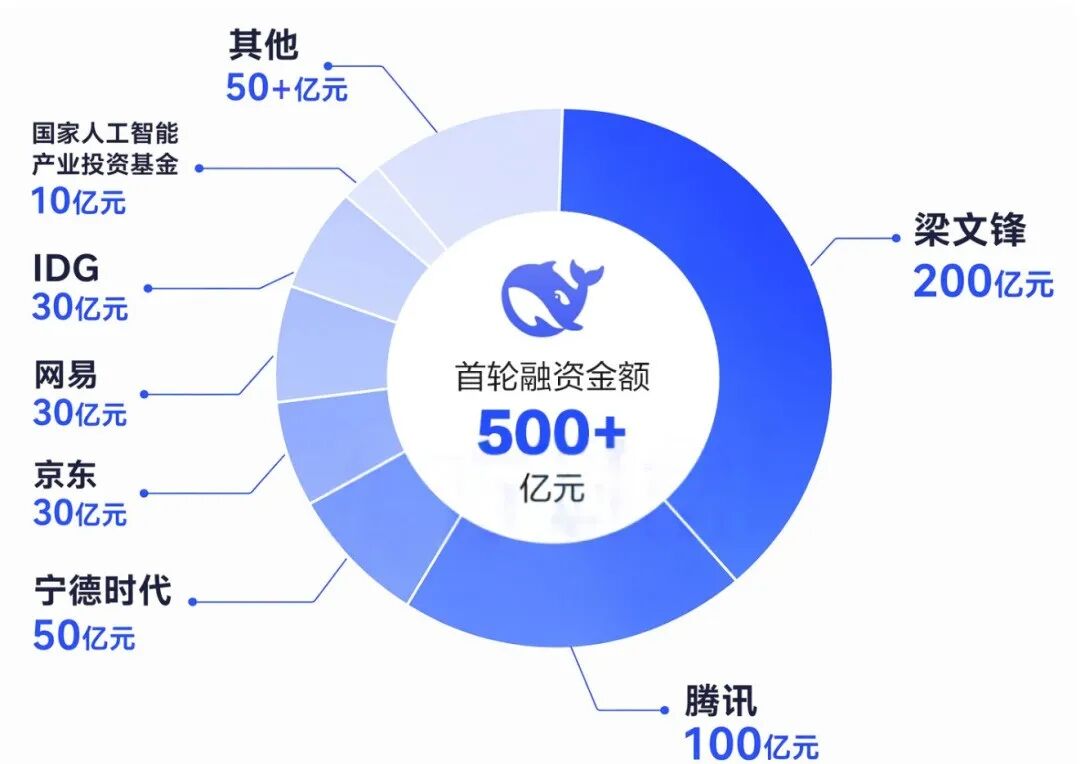
Translated into vernacular: When money comes in, no one can touch the steering wheel. A financing created the magical drama of "Party A becomes Party B" - the person who theoretically needed to be invested actually spent the most money, and the relationship between host and guest was completely reversed.
Triple control insurance
Liang Wenfeng's protection of control rights was structurally designed into every legal document of the transaction.
The first level: funds go to the "pool" and not to the company. In addition to the National AI Fund, external investors are required to inject funds into the limited partnership managed by Liang Wenfeng rather than directly investing in the DeepSeek company itself. Outside investors receive a financial stake, priority in future financings, and higher access to financial information—but not voting rights. In plain English: The money you invest does not directly buy the equity of DeepSeek, but goes into a "fund pool" controlled by Liang Wenfeng.
The second level: five-year lock-in period. Most investors cannot sell their interests within five years and cannot withdraw at will midway. In the impetuous AI track of "three years to go public, five years to retire", a five-year lock-in period is equivalent to cutting off the idea of short-term arbitrage. The DeepSeek team also requires verification of the true identity of the limited partners behind all investment funds to avoid the risk of equity eventually flowing into the hands of unknown entities.
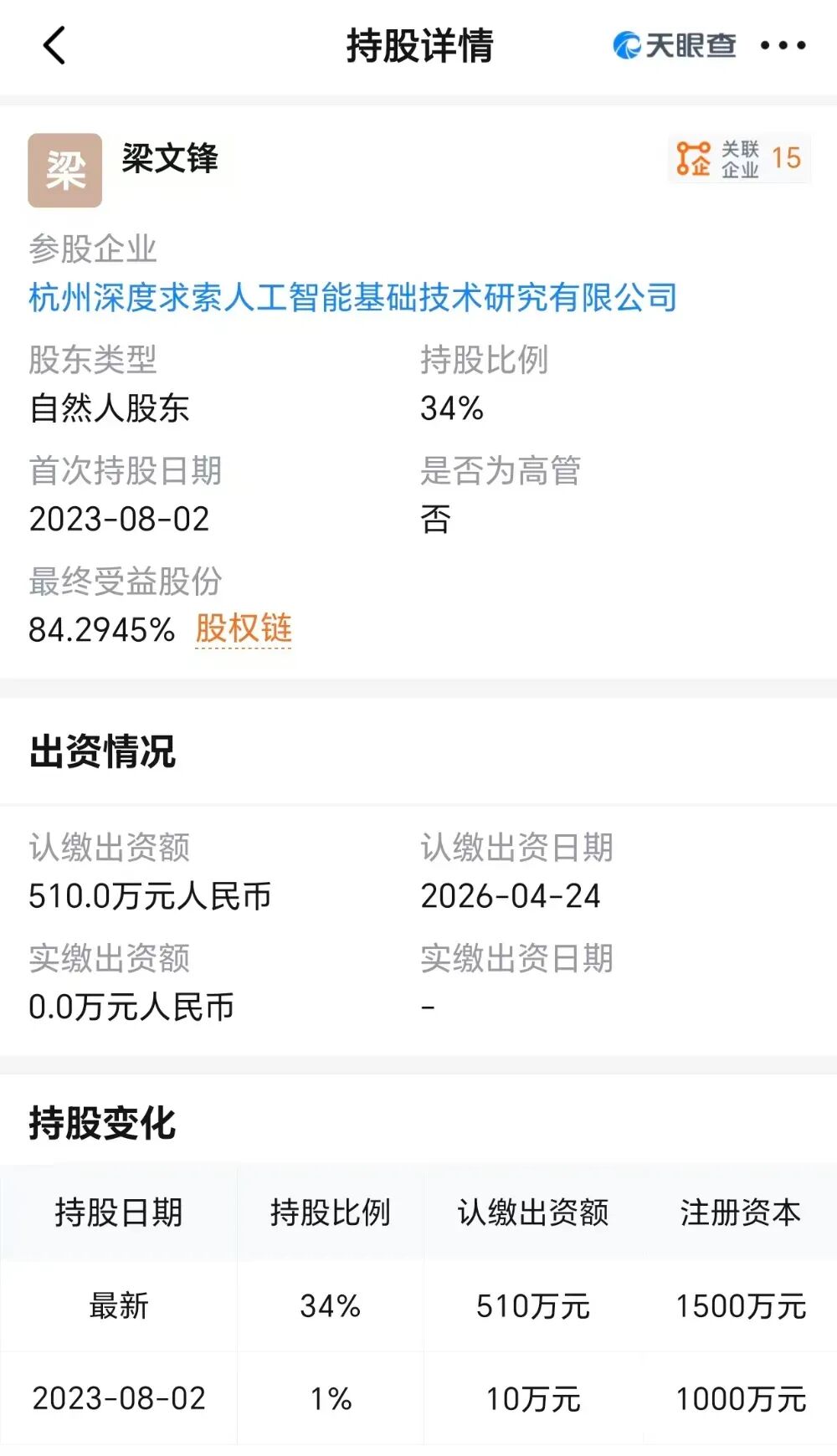
Third level: The ownership structure is welded. Before the financing, Liang Wenfeng first increased his personal direct shareholding ratio from 1% to 34% through industrial and commercial capital increase. After adding the indirect shareholding of Huanfang company, the final beneficial shares reached 84.29%, holding 100% voting rights. The only exception is the direct investment of about 1 billion yuan by the National AI Fund, which enjoys voting rights and is not subject to a lock-in period. Even institutions of Tencent's magnitude can only be purely financial investors in this round of financing - they get in but can't get on the table.
Strong confidence: Magic Square’s quantified cash machine
Liang Wenfeng's courage to design such a "domineering" transaction structure lies in his other identity - the founder of China's leading quantitative private equity firm Magic Square Quantitative. Magic Square quantifies that the current management scale exceeds 70 billion yuan, and the average income in 2025 is 56.55%, the average in the past three years is 85.15%, and it has reached 114.35% in the past five years. No matter how volatile the secondary market is, it can continue to generate considerable management fees and performance shares every year. This is a cash machine that does not rely on any external blood transfusion and can produce blood on its own.
DeepSeek was established in July 2023. It was initially just an AI business department incubated internally by Magic Square Quantification. In the first three years of its establishment, there was almost no external financing, and all R&D investment was supported by its own funds. This is extremely rare in the large-model track where money is burned like water - most players in the industry rely on VC blood transfusions, and each round of financing must hand over growth curves and commercialization stories. It is inevitable to adjust strategies according to the rhythm of financing, and the space for long-term technology accumulation is compressed.
Because of this, the core appeal of this round of financing from the beginning was not to fill the funding gap, but to solve two more specific problems:
First, market-based pricing for employee options. In the past year, at least five core R&D members of DeepSeek have confirmed their resignation: V3 core contributor Luo Fuli was poached by Lei Jun to Xiaomi with an annual salary of tens of millions. The model launched by her MiMo team has surpassed DeepSeek similar products in some benchmark tests; R1 core researcher Guo Daya joined Byte; Wang Bingxuan, the core author of the first-generation large language model, went to Tencent. There is no circulation market for options in unlisted companies, and the incentives in the hands of employees are simply paper - rather than financing, it is more about giving talents a market-oriented answer to "how much are your options worth?"
Second, reserve computing power ammunition for next-generation model training. The computing power requirement in the AI Agent era is a game of another magnitude. The rolling accumulation of magic square profits alone is no longer enough to cover the next stage of competition.

This is a round of financing with a clear strategic purpose, rather than a rescue move that is forced to go out and find a way to survive. It is this level of cash flow confidence that makes insisting on open source and deepening the long-term AGI route no longer just a sentimental statement by the founder, but a real choice with institutional support and financial backing.
Route breakthrough: Breaking out of the Silicon Valley coordinate system
In the past two years, the domestic AI industry has always been unable to avoid a set of narrative frameworks that benchmark against Silicon Valley - OpenAI financing has followed the financing wave in China, Google has closed source and discussed the life and death of open source in China, and Nvidia chips are scarce and there is collective GPU anxiety in the country. Few people stop to ask: Does China’s AI development have to take that path?
DeepSeek’s combination of absolute control by the founder, self-owned cash flow support, binding domestic computing power base, and adhering to the long-term open source route cannot be found in any corresponding sample in the Silicon Valley entrepreneurial template. It neither belongs to the VC-driven model shaped by YC, nor is it different from the classic approach of major domestic Internet companies that uses traffic ecology to bind market share. This is a path that grows out of its own business genes, not a replica copied from an external script.
A detail worth mentioning separately: the National AI Fund directly invests about 1 billion yuan, retains voting rights and is not subject to a lock-in period - this is the only exception in the entire structure. DeepSeek rejects the control rights of all institutions in terms of business logic, but leaves an always-open door for the national team in terms of computing power. This is not a contradiction, this is reality: computing power, as a strategic resource in the AI era, is destined to find a balance between national strategy and corporate autonomy.
In fact, at the same time as DeepSeek V4 was released, Huawei announced that the entire range of Ascend super node products fully supports the DeepSeek V4 series models. Ascend 950 and Ascend A3 super nodes have completed core mold technology collaborative adaptation, and provided a training reference implementation based on Ascend A3 to support the full process implementation of the model from training to inference. Many industry insiders said that this marks that domestic large models and domestic computing power chips have opened up the entire process from training to deployment.
Of course, challenges on this road cannot be avoided - the cost of training cutting-edge models continues to rise, the commercial costs of open source are increasing year by year, and whether personal will can effectively balance the laws of the industry in the long term. But one thing is certain: DeepSeek has opened up an independent path for Chinese AI that no longer needs to refer to the Silicon Valley coordinate system to measure itself.
The implementation of 50 billion financing is a milestone in industry differentiation. Liang Wenfeng took a path that could not be written in Silicon Valley: the founder held 84% of the shares and spent the largest amount of money himself. The national team followed in the investment but only in terms of computing power, and the model route was deeply tied to domestic chips. When the carnival of capital ebbs, the one who laughs last may not be the one with the most money, but the one who holds the entire deck of cards in his own hands.
Several directions worthy of continued follow-up:
- The actual effect of option incentives: Can market-based pricing really stop the loss of core researchers? Will the number of cases of 5 people who have resigned continue to increase?
- Huawei Ascend Adaptation Progress: Can the gap between V4’s actual inference performance on Ascend and NVIDIA continue to narrow? Commercial deployment progress after full stack adaptation
- V4.1 Multimodal Commercialization: Pricing and delivery methods for enterprise-level multimodal models planned to be launched
- Strategic synergy of "non-voting" shareholders: How do Tencent, CATL, etc. achieve industrial synergy with DeepSeek when they lack the right to speak?
- Long-term decoupling of Magic Square and DeepSeek: Will fluctuations in quantitative business profits affect the continued infusion of DeepSeek? Will there be further independence in the future?
Reviews