DeepSeek recruits "civilian engineer": self-built GW-level data center, computing power map shifts from leasing to self-built
DeepSeek's official website has newly launched the position of IDC design and planning engineer. JD clearly mentioned "from MW to GW level infrastructure planning and construction", which marks the shift of computing power strategy from cloud leasing to self-built data centers. Jobs at the Ulanqab Data Center in Inner Mongolia have been released before.
"You will have the opportunity to participate in the planning and construction of infrastructure from MW (megawatt) to GW (gigawatt) levels."
The newly launched IDC design and planning engineer position on DeepSeek's official website uses a JD preface to announce a major shift in computing power strategy - from cloud leasing to self-built data centers. IDC design and planning engineers belong to the core technical position of computing infrastructure. They are responsible for the full-process planning and design of the data center from preliminary site selection, plan layout to construction drawings and implementation support. They are the core technical person in charge of the early stage of computer room construction.


Job details: 7 core responsibilities and 5 attractive promises
DeepSeek lists 7 main responsibilities for this position, covering the entire process from planning architecture to special optimization:
- Planning and Architecture: Participate in data center campus planning, computer room planning and infrastructure architecture design
- System Review: Participate in the review and optimization of power systems, refrigeration systems, cabinet systems, network infrastructure, etc.
- Frontier Technology Research: Research and evaluate new technology routes such as liquid cooling, high-density power supply and distribution, modular construction, and intelligent operation and maintenance.
- Specification output: Output design specifications, technical standards, equipment selection strategies and capacity planning plans
- Cross-border collaboration: Collaborate with design institutes, equipment manufacturers, construction teams and operations teams to promote project delivery
- Industry Research: Participate in research on global data center and AI infrastructure industry trends
- Special Optimization: Carry out special analysis and solution optimization for key indicators such as cost, reliability, energy efficiency, scalability, etc.
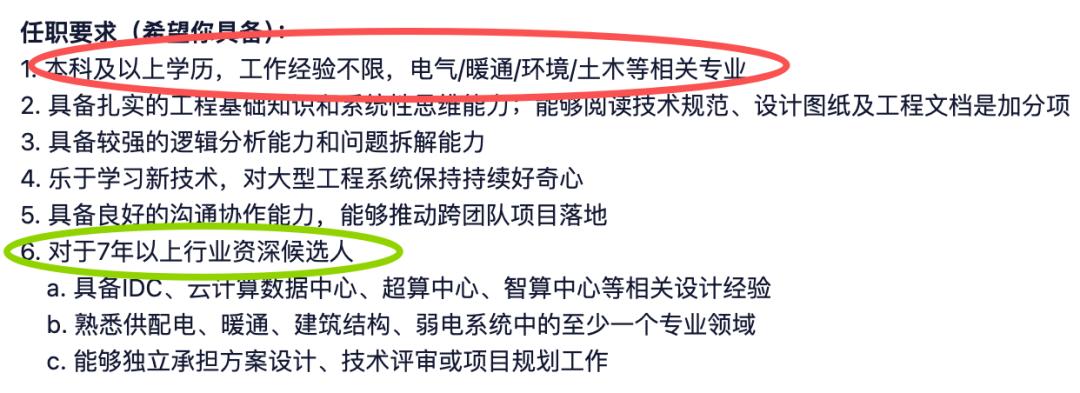
The "no work experience limit" signal in the JD position is quite friendly. At the same time, an independent advancement channel is prepared for senior candidates with more than 7 years of experience. Liang Wenfeng not only wants to recruit fresh blood with systematic thinking, but also urgently needs mature architects who can independently carry out the job.
The 5 commitments written in "You Can Get" make this HC look really exciting: participation in the planning and construction of infrastructure from MW to GW, contact with multi-field teams such as the Internet/chip/server/energy/power/refrigeration, each system designed may affect the operating efficiency of tens of thousands of GPUs and hundreds of thousands of servers in the future, contact with cutting-edge technologies such as AI intelligent computing centers/high-density GPU clusters/liquid cooling and advanced cooling technology/new power supply and distribution architecture/automated operation and maintenance and digital twins.
What does a GW-scale data center mean?
1 GW = 1000 MW = 1 billion watts. Before the AI 2.0 era, the power capacity of global "hyperscale" data centers was usually between 50-100MW, and a few leading projects could reach 200-300MW. After entering the era of AI training and inference, power demand has increased exponentially.

There are currently only two public GW-level AI data center projects in the world: Stargate, a collaboration between OpenAI and Microsoft, plans a single campus of 5GW, a long-term total of 30GW, and an investment budget of US$100-500 billion; Musk's Colossus cluster in Memphis, Colossus 1 will be online in September 2024 and deploys approximately 230,000 GPUs, and Colossus 2 has been launched in January this year It operates every month and is known as the world’s first gigawatt-level training cluster. If DeepSeek builds its own GW-level data center, its ambition is self-evident.

Computing power landscape: from "borrowing a ship to go to sea" to "building a ship and sailing"
Following the timeline, DeepSeek's computing power strategic path is clearly discernible: from Hangzhou Iron and Steel Cloud Computing Data Center (leasing), to Ulanqab, Inner Mongolia (self-built project), to recruiting core IDC design and planning talents at the Hangzhou headquarters - the computing power landscape is shifting from "borrowing ships to go to sea" to "building ships and sailing".
The emergence of this HC is highly consistent with DeepSeek’s 50 billion first round of financing on the timeline. Among the financing purposes, "increasing computing power investment" has been given top priority by many parties, and the technical directions highlighted in the recruitment notice - high-density GPU clusters, liquid cooling, new power supply and distribution architecture, digital twin operation and maintenance - indicate that DeepSeek will most likely break out of the traditional IDC standard construction model and develop a customized infrastructure that can squeeze out every ounce of GPU computing power.
But a practical challenge cannot be avoided: in the current AI industry and energy infrastructure field, it only takes 1 to 2 years to build a 1GW data center and install the cards, but it takes 5 to 8 years to wait for the power grid and the supply chain to be completed**. Every time a new model is released, will the wait get longer and longer? This is the time account that DeepSeek must face on its own road to self-construction. During the same period, CATL spent about 15.5 billion yuan to continuously lay out AI infrastructure (Zhongheng Electric HVDC, 21Vianet Data Center). DeepSeek's self-built GW-level data center and the energy storage and power supply solutions of investor CATL happened to form a complete computing power-energy closed loop.
Reviews